What Is Important For Light Fixtures In Food Prep Area?
Stand at your counter and your own body blocks the overhead light — putting a shadow right where you're cutting. That's why task lighting placement matters more than how many lumens your kitchen has.
 Eugen
EugenEugen Nikolajev
Creator of LED Lighting Info
Hi, I am Eugen. I was always one of those kids who had all sorts of weird lighting gadgets for every occasion.
Now, I want to share my knowledge and experience about lighting with you on LED Lighting Info.
Read my editorial standards
Key Takeaways
For a home kitchen, aim for 50–75 foot-candles (roughly 540–800 lux) on prep surfaces and 30–40 foot-candles (320–430 lux) for general ambient light. Commercial kitchens follow the FDA Food Code, which mandates 540 lux at prep surfaces and IP65-or-better sealed fixtures.
Most home kitchens are dramatically under-lit at the work surface, and it's one of the most common renovation oversights.
Sharp knives and weak lighting are a bad combination, so getting brightness right at the counter, not just overhead, matters more than the fixture you choose.
Below, I cover:
- Layered lighting design for home kitchens (ambient, task, accent)
- Color temperature, CRI, and dimmer compatibility
- Whether LED lights can affect your food
- Commercial kitchen lighting regulations
Things To Keep In Mind When Designing Home Kitchen Lighting
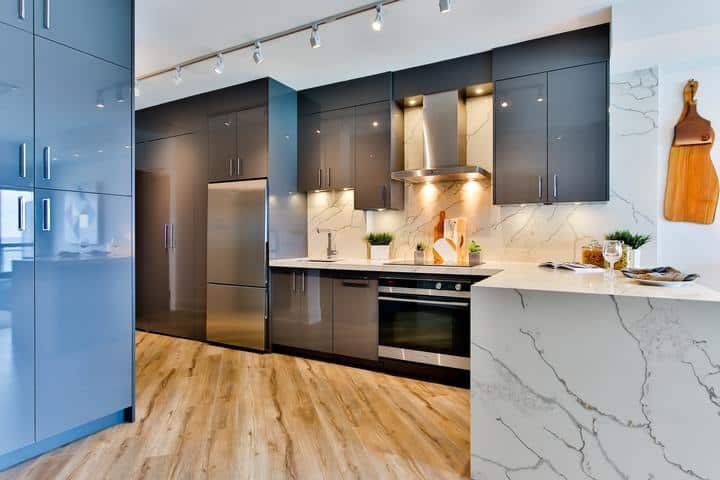
There are no federally mandated illumination-level requirements for home kitchens, though the National Electrical Code (NEC §210.70) does require at least one wall-switch-controlled lighting outlet, with lighting on a separate circuit from small-appliance receptacles and AFCI/GFCI protection. For brightness, plan around the three layers of lighting: ambient, task, and accent.
Ambient Lighting
Ambient lighting covers the whole room. Pendant lights, flush-mount fixtures, or recessed spotlights all work — the fixture choice is mostly aesthetic. What matters is total output.
Aim for 30–40 foot-candles (320–430 lux) of ambient light. To convert that into bulbs, you need the room area and a quick understanding of the units.
Foot-Candles vs. Lux
Both units measure illuminance — how much light lands on a surface. The difference is just the area unit:
| Measurement | Definition | Use case |
|---|---|---|
| Foot-candle (fc) | Lumens per square foot (lm/ft²) | Imperial (US) |
| Lux (lx) | Lumens per square metre (lm/m²) | Metric |
| Conversion | 1 fc ≈ 10.76 lux | — |
To work out total lumens, multiply the room area by the recommended foot-candle (or lux) figure. The result is the total lumens you need across all your ambient bulbs combined.
Worked example — Imperial
- Room size: 12 ft × 16 ft = 192 sq ft
- Minimum lumens: 192 × 30 = 5,760 lm
- Maximum lumens: 192 × 40 = 7,680 lm
Worked example — Metric
- Room size: 3.5 m × 3.4 m ≈ 12 sq m
- Minimum lumens: 12 × 320 = 3,840 lm
- Maximum lumens: 12 × 430 = 5,160 lm
These are two different example rooms (192 sq ft is closer to 17.8 sq m), so the totals don't line up — pick the example that matches your units.
Once you know your total lumen target, divide by the output of a typical bulb for your chosen fixture. With 1,500-lumen bulbs, the smaller example needs about four; the larger one needs five.
Task Lighting
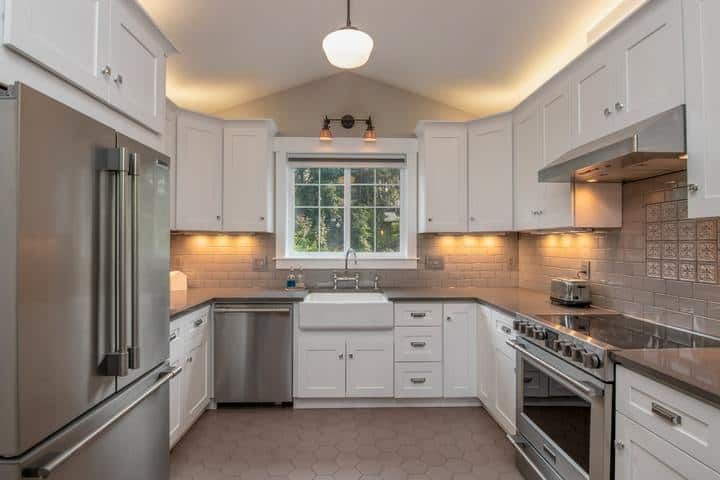
Task lighting targets specific work areas — countertops, the hob, the sink. It needs to be brighter than ambient: 50–75 foot-candles (roughly 540–800 lux) is the IES recommended range for residential kitchen work surfaces, and the FDA Food Code requires a minimum of 540 lux (50 fc) on commercial prep surfaces.
Your ambient lights might cover some of this, but if you stand facing a counter you'll cast a shadow onto your own work — exactly where you don't want one. There are two ways to deal with this:
| Approach | Pros | Cons |
|---|---|---|
| Reposition main lights (e.g., spotlights) | No extra fixtures needed; cleaner ceiling | Shadows still possible when standing at counter; less flexibility once installed |
| Dedicated under-cabinet task lights | Eliminates shadows; consistent brightness on the surface; can be switched independently | Extra wiring; additional fixture cost |
The second option is generally preferred — under-cabinet strips or pucks deliver consistent light right where you're cutting, regardless of where you stand. Calculate the lumen target the same way: multiply the work-surface area by the foot-candle or lux figure.
Accent Lighting
Accent lighting is the third layer — purely a design feature, not essential to using the kitchen. Common choices are toe-kick lighting at floor-level cabinets, shelf strips, or up-lighting on top of wall units.
There's no specific brightness target. Just keep accent output below your ambient level so it adds atmosphere without competing with the working light.
Color Temperature
Color temperature, measured in kelvin (K), determines how warm or cool the light looks — and it has a big effect on how food appears. For kitchens, 3000–4000K is the practical range:
- 2700K (warm white) — cosy, but can make raw meat and greens look dull
- 3000–3500K (soft white) — a good compromise for open-plan kitchens that double as social spaces
- 4000K (neutral white) — crisp and natural, the best general choice for cooking visibility
- 5000K+ (daylight) — clinical; usually too cold for a residential kitchen
My rule of thumb: pick 4000K for task lights at the counter and 3000K for ambient if you want a warmer overall feel.
CRI (Color Rendering Index)
CRI rates how accurately a light source renders colors compared to natural daylight, on a 0–100 scale. For a food prep area this matters more than people realize: high CRI helps you spot whether meat is fully cooked, whether produce has spoiled, or whether bread crust is golden vs. burnt.
Look for CRI 90+ on any fixture above a prep surface. Cheaper LED bulbs often run CRI 80, which is fine for ambient light but flattens reds and oranges noticeably.
Dimmer Compatibility
If you want dimmable kitchen lighting, the LED bulb or fixture must be explicitly labeled dimmable, and the dimmer switch must be LED-compatible. Pairing a non-dimmable LED with a dimmer — or a standard incandescent dimmer with an LED — causes flicker, buzzing, or burned-out drivers. Match both halves before you buy.
Wet and Steam Zones
IP ratings matter in home kitchens too, not just commercial ones. Above the hob and directly over the sink, fixtures see steam, splashes, and grease. Use IP44 or higher for these spots. UK installations are also subject to BS 7671 zone rules in any kitchen with a sink, which dictate minimum IP ratings depending on proximity to water.
Commercial Kitchen Lighting Regulations
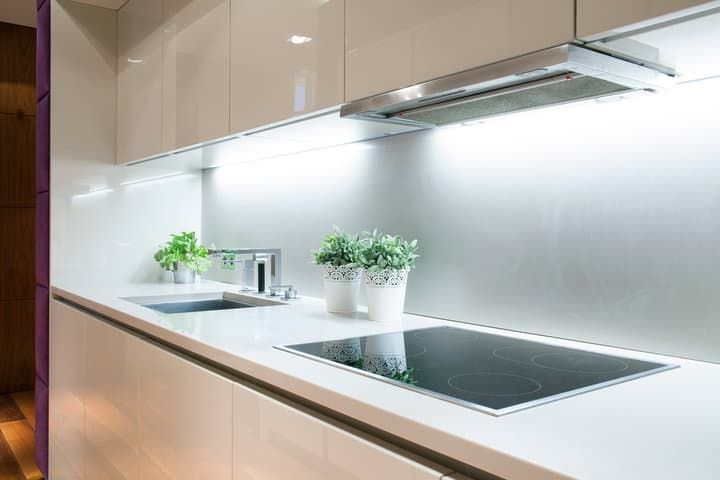
If you're opening a restaurant, the rules are stricter. In the US, the FDA Food Code §6-303.11 — adopted by most state and local health departments — sets the minimum illumination by area:
| Area | Minimum illumination | Foot-candles |
|---|---|---|
| Surfaces where staff work with food, knives, slicers, or grinders | 540 lux | 50 fc |
| Handwashing, warewashing, equipment storage, reach-ins, self-service displays | 220 lux | 20 fc |
| Walk-in refrigeration and dry storage | 110 lux | 10 fc |
The often-cited 1,000-lux figure for cooking lines isn't a regulatory minimum — it comes from Illuminating Engineering Society (IES) recommended-practice guidance, which suggests 750–1,000+ lux at active cooking stations for visibility and safety. Treat it as a target, not a code requirement.
OSHA's general industry standards (29 CFR 1910) take a performance-based approach and don't publish a specific lux value for commercial kitchens, so the FDA Food Code is the document to follow.
Fixtures must also be sealed to withstand washdowns and prevent broken-glass contamination. IP65 is the typical minimum (dust-tight and protected against water jets), with IP66 or higher recommended directly over cooking equipment. IP67 — temporary submersion — is overkill for general kitchen ceilings and rarely required.
Can LED Lights Affect Food?
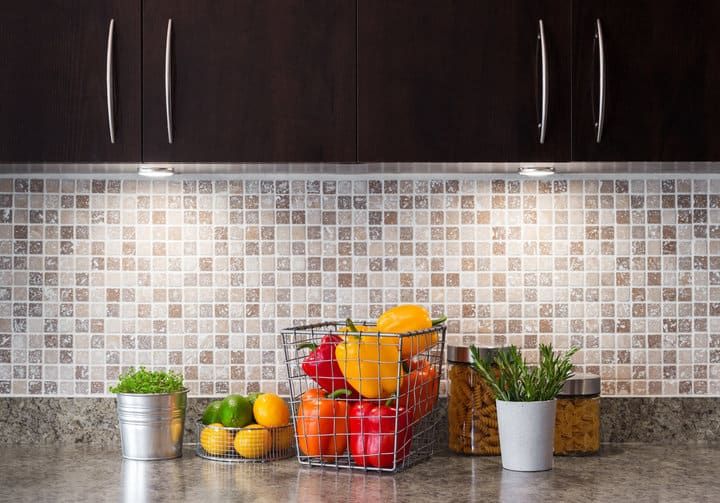
In a normal home kitchen, no — LEDs don't damage or alter food. A fruit bowl under your wall cabinets is fine, even with under-cabinet strips running.
Where LEDs make a difference is in long, close-proximity exposure — supermarket display cases, for example. Older incandescent and halogen bulbs run hot and can ripen produce too quickly or wither leaves. LEDs run cool, so that thermal effect disappears.
The same is true inside refrigerators. Older fridges used incandescent bulbs, which didn't spoil food (the cooling system compensated) but did force the compressor to work slightly harder. LED interior lighting reduces that load — a small efficiency win on top of the bulb's own energy savings.
Final Words
Kitchen lighting comes down to three steps:
- Measure the room area to size your ambient lumens (30–40 fc / 320–430 lux).
- Add task lighting at 50–75 fc (540–800 lux) on every prep surface, ideally under-cabinet.
- Layer in accent lighting last — and pick fixtures with CRI 90+, 3000–4000K color temperature, and an appropriate IP rating for wet zones.
Get those right and the kitchen will be safer, more pleasant to cook in, and far less prone to the dim, shadowy counters that plague most renovations.