
How Much Electricity Does It Take To Turn On A Light?
A cold incandescent filament has roughly 1/15 the resistance of a hot one — and that's exactly why the "leave it on" myth has persisted for decades. With LEDs, the math kills the myth completely.
 Eugen
EugenEugen Nikolajev
Creator of LED Lighting Info
Hi, I am Eugen. I was always one of those kids who had all sorts of weird lighting gadgets for every occasion.
Now, I want to share my knowledge and experience about lighting with you on LED Lighting Info.
Read my editorial standards
Key Takeaways
With incandescent and CFL bulbs, more power is used briefly when switching on a bulb, but this surge is negligible on your bill. LEDs require no meaningful extra power to switch on. In almost every case, it’s best to switch off lights when you’re not using them, both to cut energy costs and to preserve bulb life.
Flip a switch and an incandescent bulb can briefly pull about ten times its normal current as the cold filament heats up — a spike that lasts roughly a tenth of a second. That tiny surge has fueled a stubborn question for decades: is it actually cheaper to leave lights on than to keep flipping them off?
The short answer: with modern LEDs, switch them off whenever you leave the room. The startup surge is negligible, the bulb doesn’t mind, and the savings are real over a year. Older fluorescent (CFL) and incandescent bulbs need a little more nuance, which I’ll walk through below.
One bit of context before the numbers: most incandescent bulbs were phased out in the US under federal efficiency standards that took effect in August 2023, and CFLs are being discontinued in step. LEDs are now the standard for new purchases, but the physics still matters for fixtures already in your home.
How much electricity does it take to turn on a light? Is it better to leave lights on or switch them off when you’re leaving the room?
In this article:
- How much energy a bulb uses at startup
- How long bulbs last and how switching affects lifespan
- How much money you save by turning lights off
- Whether to leave lights on or switch them off
Does Turning a Light On Use More Electricity Initially?
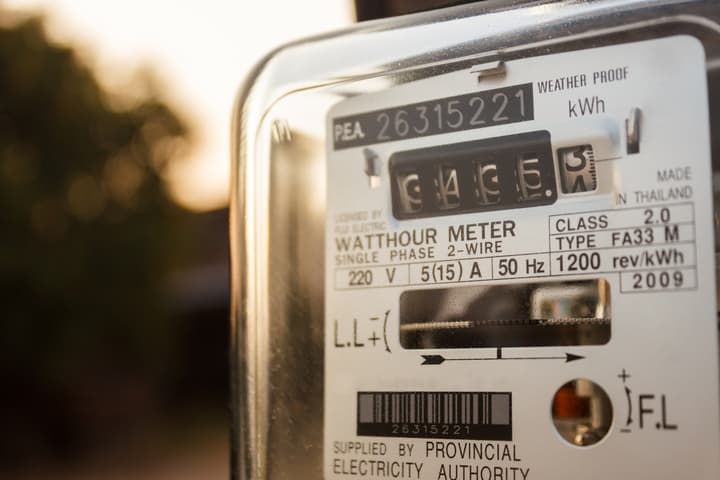
Some bulbs do. Some don’t.
With an incandescent bulb, the cold tungsten filament has roughly 1/15 the resistance of the hot filament — a 100W/120V bulb measures about 9.5Ω cold versus ~144Ω at operating temperature. That low cold resistance lets a brief inrush current of up to 10× the normal draw flow through the filament. The current stabilizes in less than a tenth of a second; higher-wattage bulbs may take closer to a full second to reach equilibrium.
CFL bulbs also pull a startup surge, but for a different reason. The electronic ballast inside the bulb has to generate a high starting voltage — often 1,000V or more — to ionize the mercury vapor in the tube. Until ionization happens, the unlit tube acts as an insulator. Once the gas is ionized and conducting, the ballast drops back to its normal operating output.
LED bulbs effectively skip this step. The driver and the diodes themselves don’t need a high-voltage strike or a warm-up period, so there’s no meaningful startup surge.
None of these surges show up on your bill in any noticeable way — they last hundreds of milliseconds at most. The reason any of this matters isn’t electricity cost. It’s bulb lifespan.
Do Light Bulbs Last Longer If Kept On?
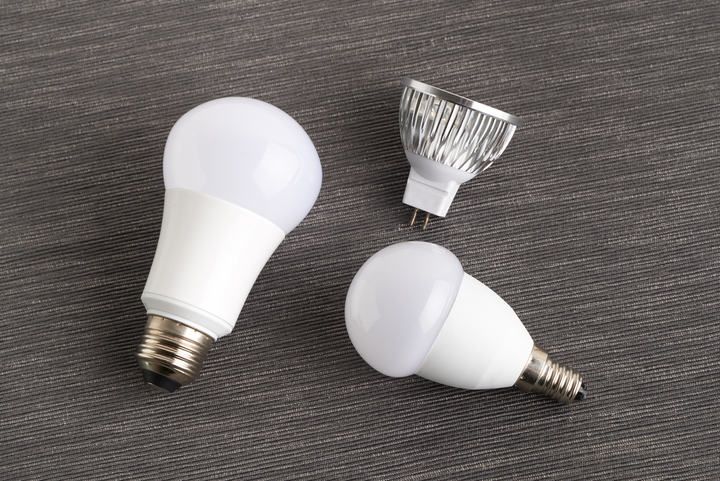
Bulb life is rated in hours, but how much switching reduces that life depends entirely on the bulb type.
Incandescent bulbs contain a thin tungsten filament that wears down with every heating cycle. Switching them on and off does shorten lifespan, but extended heat is harder on them: roughly 90% of the energy goes out as heat rather than light. Leaving an incandescent on for hours wastes far more bulb life (and electricity) than switching it off when you leave the room.
CFL bulbs are far more sensitive to switching. Each on/off cycle stresses the electrodes inside the tube, and short cycles dramatically reduce lifespan. The Department of Energy’s practical rule is to leave a CFL on if you’ll be back within 15 minutes, and switch it off if you’ll be gone longer.
You may have seen a much shorter threshold of around 25 seconds floating around online. That’s the pure energy break-even point — where the startup surge equals the energy saved by switching off — and it ignores wear from cycling. The 15-minute number is the one to follow in practice, because it weighs energy savings against the lifespan hit from frequent switching.
LED bulbs work differently. ENERGY STAR-qualified LED bulbs are rated for at least 25,000 hours; premium and commercial-grade models can reach 50,000 hours, but a typical residential A19 bulb is usually rated 15,000–25,000 hours.
Switching an LED on and off causes minor thermal cycling stress on the diodes and the driver’s electrolytic capacitor, but under normal household use the effect is negligible — you’re not going to wear an LED out by flipping the switch a few extra times a day. Heat is a much bigger killer than switching, which is why an LED in a poorly ventilated enclosed fixture often fails earlier than the spec suggests.
| Bulb type | Rated lifespan | Sensitive to switching? | Recommended off threshold |
|---|---|---|---|
| Incandescent | ~1,000 hours | Slightly | Switch off whenever leaving the room |
| CFL | 8,000–10,000 hours | Significantly | Leave on if back within 15 minutes |
| LED | 15,000–25,000+ hours | Minimally | Switch off whenever leaving the room |
How Much Money Does Turning the Light Off Save?
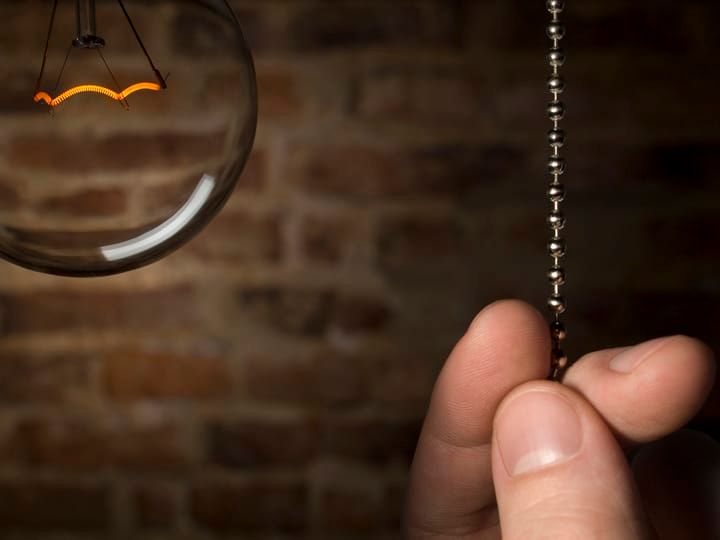
Now to the math. A 60W incandescent draws 60 watts of power; over one hour it consumes 60 watt-hours, or 0.06 kWh. (Watts are already a rate — energy per time — so saying a bulb uses “60 watts per hour” is a units error you’ll see a lot online.)
As of 2026, the US residential electricity average is around 17¢/kWh, though state rates range from roughly 11¢ in Idaho and Washington to over 40¢ in Hawaii and California. Using the national average, running that 60W bulb for one hour costs about 1.02¢.
Switch it off for 30 seconds and you save 1/120 of that — about 0.0085¢. That’s a fraction of a cent, but the comparison only gets interesting when it stacks up across more bulbs, more time, and more days. Here’s how the savings on a single 60W incandescent bulb scale across longer off periods:
| 1 bulb off for 30 seconds | 1 bulb off for 30 minutes | 1 bulb off for 1 hour |
|---|---|---|
| 0.0085¢ | 0.51¢ | 1.02¢ |
An hour isn’t unrealistic. Think about how often you leave the room for a bathroom break or to grab a snack and end up gone longer than you meant to. Those small increments add up.
Now consider four bulbs — a fair count for a kitchen, living room, or bathroom with multiple fixtures.
| 4 bulbs off for 30 seconds | 4 bulbs off for 30 minutes | 4 bulbs off for 1 hour |
|---|---|---|
| 0.034¢ | 2.04¢ | 4.08¢ |
Projected over a calendar year, with each scenario playing out once per day for 365 days:
| 4 bulbs, 30 seconds × 365 days | 4 bulbs, 30 minutes × 365 days | 4 bulbs, 1 hour × 365 days |
|---|---|---|
| 12.4¢ | $7.45 | $14.89 |
That’s one person, in one room. With four people in a household acting the same way, the savings roughly quadruple — close to $60 a year for the one-hour-per-day case at current rates. Apply it across multiple rooms with more bulbs and the dollars add up fast.
One important caveat: most US fixtures are running LEDs by now. A 60W incandescent puts out about 800 lumens of light, the same brightness you can get from an 8–10W LED. The savings math at the LED end of the scale is much smaller per bulb-hour — about 0.15¢/hour instead of 1.02¢ — but the underlying point still holds. Turn lights off when you don’t need them and the dollars accumulate over the course of a year, especially across larger homes and longer absences.
Let Smart Switches Do the Work
If remembering to flip the switch isn’t your style, automate it. Occupancy sensors and motion-activated switches in hallways, closets, bathrooms, and laundry rooms are the closest thing to a free win in home lighting — they kill the lights automatically when the room is empty.
Smart bulbs and smart switches add scheduling and per-room automation, and most are LED-based, so the underlying bulb tolerates frequent switching just fine. If you’re pairing a smart dimmer with LED bulbs, double-check that the dimmer is rated for LED loads. Many older incandescent dimmers don’t play well with LEDs and cause flicker, buzzing, or limited dimming range.
What’s the Best Approach?
Quick rules of thumb by bulb type:
- LED — Switch off whenever you leave the room. The diodes don’t care.
- CFL — Leave on if you’ll be back within 15 minutes; otherwise switch off. Frequent short cycles shorten life sharply.
- Incandescent — Switch off. The wasted heat outweighs the small lifespan hit from cycling, and swap them out for LEDs as they fail.
Beyond the bill, there’s a quality-of-life angle. Warm bulbs around 2,700K are easier on sleep cycles than cool 5,000K daylight bulbs in the evening, and reducing unnecessary indoor light at night helps your circadian rhythm. If you tend to leave a hallway light on overnight, a low-wattage warm-white LED on a motion sensor is a better default than a constantly burning bulb.
Final Words
My rule, after running the numbers: switch lights off when you leave the room, replace any remaining incandescent or CFL bulbs with long-life LEDs as they fail, and put motion sensors on the lights you most often forget. It’s the cheapest, lowest-effort version of an energy upgrade — no rewiring, no smart-home subscription, just a small habit and a bag of bulbs.