
How Many Feet Of LED Strip Lights Do I Need For My Room? (Perimeter Calculator)
Around 1500 lumens per meter is where cove lighting really starts to shine — and buying brighter than you need is intentional, because a dim strip can't be fixed after install.
 Eugen
EugenEugen Nikolajev
Creator of LED Lighting Info
Hi, I am Eugen. I was always one of those kids who had all sorts of weird lighting gadgets for every occasion.
Now, I want to share my knowledge and experience about lighting with you on LED Lighting Info.
Read my editorial standards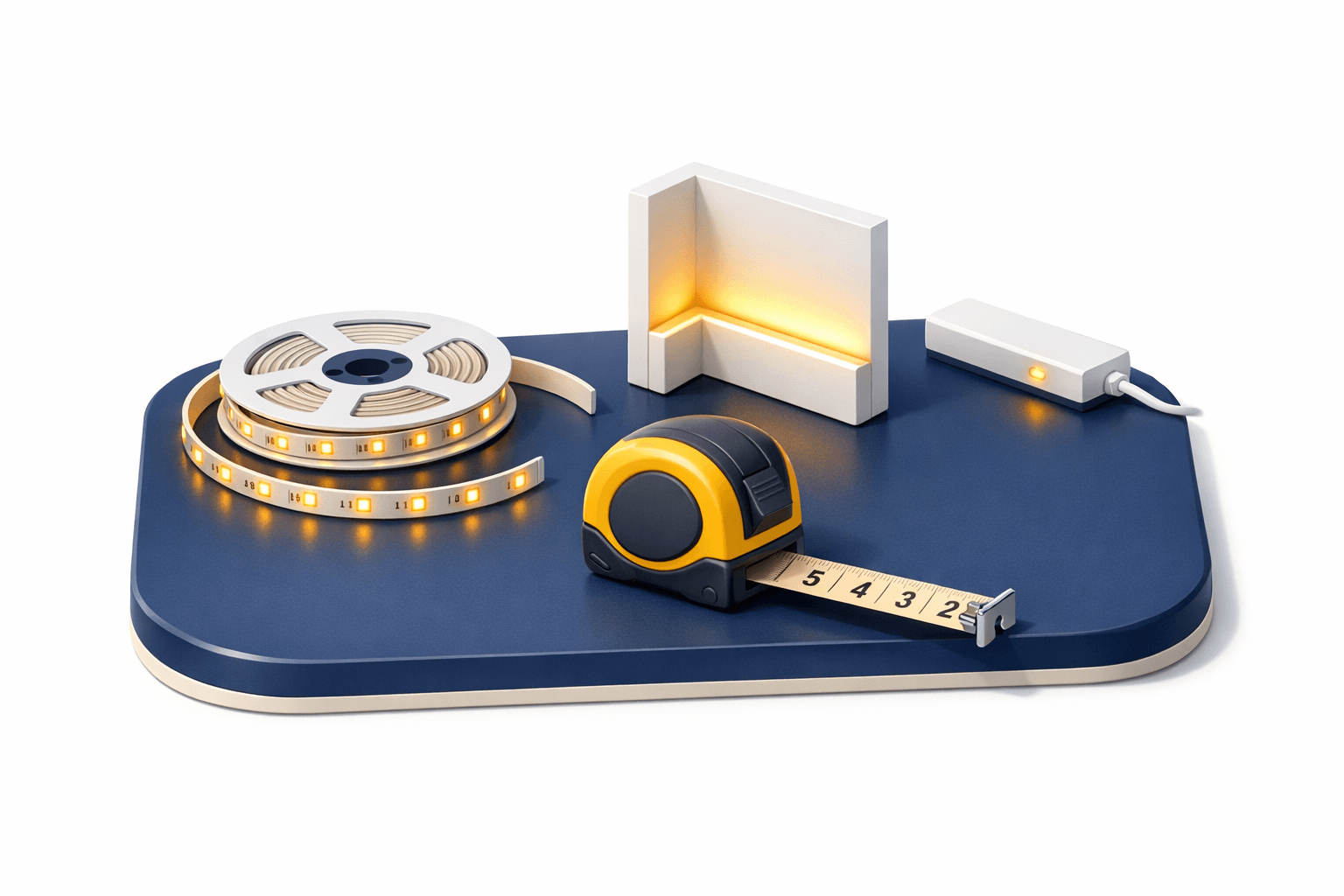
Key Takeaways
To work out how many feet of LED strip lights you need:
- Measure the perimeter of the room
- Account for any alcoves — you need to measure along every surface
- Based on the length of a single strip — typically 5 m (16.4 ft) or 10 m (32.8 ft), with some brands offering longer 15 m (50 ft) specialty reels — work out how many strips you need
- Cut the LED strip shorter if necessary
To run LED strips around your room, you need the exact perimeter length. Here's how to measure it, how much to buy, and how to avoid the most common installation mistakes.
Let's get into that in more detail, covering:
- How to measure room perimeter for LED strip lights
- Choosing the right brightness for your setup
- Whether you can use multiple LED strips
- What to do if your strip lights are too long
Room Perimeter Calculator For LED Lights
To measure the length of LED strip lights you need, simply measure the perimeter of the room. If the room is rectangular, just measure the length and width once, and double the total.
If the room has alcoves, a chimney breast, or an L-shape, you'll need to measure along every wall and keep a running list of each segment.
✏️ Pro Tip: Record each wall measurement separately — don't running-total on a calculator. One wrong button and you'll need to start over.
It helps to sketch the room on paper and add each measurement to the drawing, so you can track what you've covered and double-check the total at the end. Once you have it, you'll know exactly how long a strip to buy.
Choosing The Right Brightness For Your LED Strip
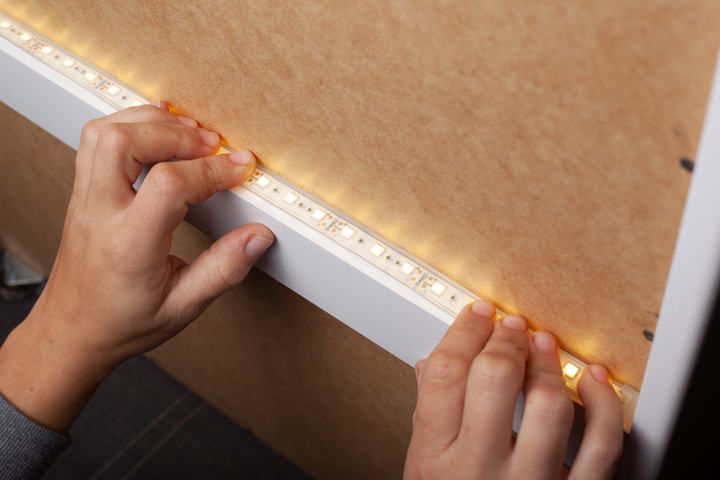
A brightness of around 1500 lumens per meter (~460 lumens per foot) gives you plenty of light for cove or crown-molding installations where some light is shielded. This is on the higher end of what's sold — most consumer strips deliver 400–1000 lumens per meter, while high-density or high-output strips reach 1500–2000+. It's better to buy brighter and dim down than to buy a dim strip you can't brighten up.
If the strips aren't shielded at all, they may feel too bright — in that case, use a dimmer switch, or buy strips with built-in dimming, a remote, or smartphone control.
Good LED strips tell you the brightness in lumens — either on the box or in the online product description.
If the strip doesn't advertise lumens, check both density and chip type. Density (30, 60, or 120 LEDs per meter) only tells part of the story — a 30 LEDs/m strip using high-output 5630 chips can outshine a 60 LEDs/m strip using older 3528 chips. As a rough guide, look for 60+ LEDs/m with 2835 or 5050 chips, or 120 LEDs/m for higher density and more even light.
Whenever possible, buy LED strips that advertise the lumen output in their spec sheet, or stick to brands you trust to use good-quality components.
Don't Forget The IP Rating
For kitchens, bathrooms, or any room where moisture is a concern, make sure your strip has at least an IP44 rating. For areas with direct water exposure — like above a shower or an exterior install — step up to IP65 or higher.
Can I Connect Multiple Strip Lights If One Is Not Long Enough?
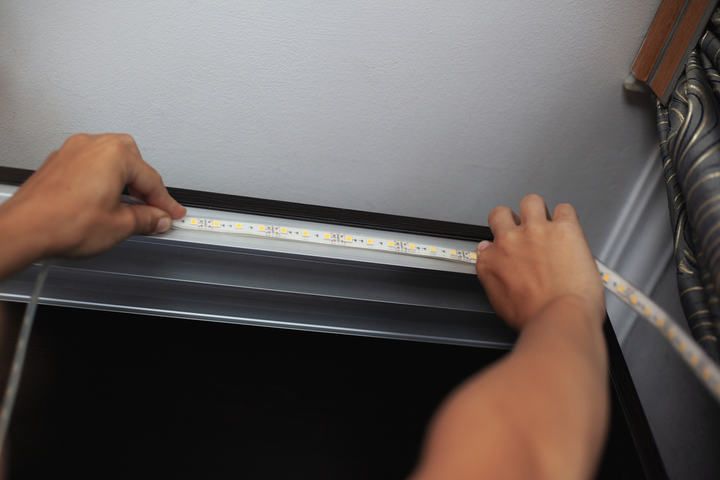
Yes — you can connect multiple strips to cover a longer perimeter. Just match voltage, avoid mixing brands, and plan for voltage drop on longer runs.
Rooms come in all sizes, so you'd have to be extremely lucky to find a reel that matches your perimeter exactly — which is why strips are designed to be cut or linked together.
There are some long LED strips (Amazon) available, but options can still fall short of what you need. Rather than hunting for multiple outlets, connect several strips and power them from one driver.
When connecting multiple strips, buy from the same manufacturer and — ideally — the same product line. Strips vary slightly in manufacturing, and mismatched strips may not be compatible, rated for the same power draw, or color-matched. Even if you can physically connect them, mismatched strips can be dangerously underpowered or overpowered.
Don't try to connect RGB strips with white strips, or even cool white with warm white — the outputs need to match.
How To Connect Strips Together
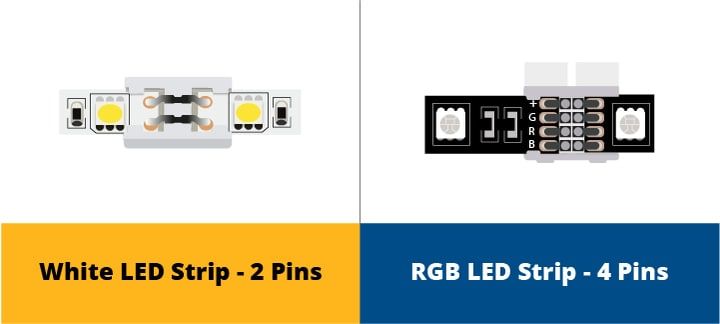
There are two common ways to join LED strip lights. Which you pick depends on how permanent the install is and how comfortable you are with a soldering iron.
| Method | Skill Level | Reliability | Best For |
|---|---|---|---|
| Snap/clip connector | Beginner | Good | Quick or temporary installs |
| Soldered joint | Intermediate | Excellent | Permanent installs, long runs |
The easiest approach is to use a connector (Amazon). Soldering takes more skill but produces a more reliable, efficient joint that's less likely to loosen or fail over time.
Match Voltage And Power Supply
The strips should be rated for the same voltage, and your power supply needs enough wattage to drive the full length. Any LED strip will tell you its watts per meter — multiply by total length to size the driver, and add ~20% headroom so the supply isn't running at its limit.
⚠️ Warning: In long runs connected end-to-end, you'll hit voltage drop — the LEDs furthest from the power source get dimmer. As a practical rule, 12V strips start to visibly dim beyond ~5 m (16 ft) from the driver; 24V strips beyond ~10 m (32 ft). For longer runs, power the strip from both ends, wire strips in parallel from a central driver, or add power-injection wires.
For a full room perimeter, running strips in parallel from a central driver — rather than one long series — is the standard professional fix. Tuck the driver somewhere accessible but hidden (inside the cove itself, above a cabinet, or behind an access panel) and route the lead wires through the same channel as the strip. My guide on connecting LED strips together walks through step-by-step wiring options.
What If My LED Strip Is Too Long — Can I Cut It?
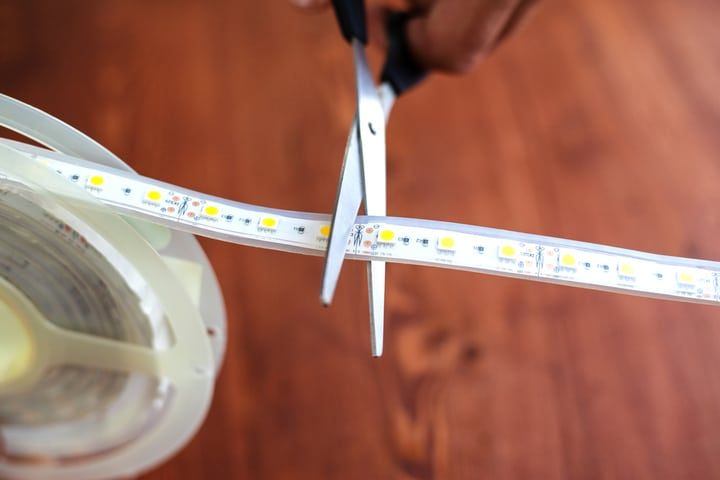
You can cut LED strips to length, but you have to cut along the designated cutting lines. These are the safe points between circuits where the strip keeps working on both sides of the cut.
Cutting lines can be dotted, dashed, or solid — the style depends on the manufacturer — but most consumer strips mark them clearly. Each line represents the end of a small circuit (typically 3 LEDs on 12V strips, 6 LEDs on 24V), so cutting on the line doesn't interrupt a live circuit.
Cutting elsewhere will usually kill the LEDs in that segment — the 3–6 LEDs between the last valid cut point and your cut. The rest of the strip upstream will normally still work. In the worst case, if you cut through a solder pad and bridge positive and negative, you can cause a short circuit that damages LEDs, resistors, or even the power supply — so always follow the cut lines.
You can re-use the piece you've cut off by connecting it to a separate driver or joining it to another strip with a connector.
A lot of people cut LED strips to use a corner connector for navigating tight bends neatly.
Final Words
Between connecting strips and cutting them to length, it's straightforward to cover exactly the perimeter you need.
Whether you're running them around the ceiling for ambient lighting or using a shorter strip for accent lighting, the same steps apply: measure accurately, pick compatible strips, and size the power supply correctly.
For more on choosing, installing, and troubleshooting strip lights, see my comprehensive guide to light strips.
FAQ
How many feet of LED strip do I need for a 12x12 room?
A 12x12 ft room has a 48 ft perimeter (4 × 12). You'd need a 50 ft (15 m) specialty reel, or a combination of shorter reels joined together — for example, a 32.8 ft (10 m) reel plus a 16.4 ft (5 m) reel. Add roughly 10% extra to account for cuts, corners, and voltage-drop margin.
How bright should LED strip lights be for a living room?
For living-room ambient perimeter lighting, 400–1000 lumens per meter (~120–300 lumens per foot) is a good target. Go brighter (1000–1500+ lm/m) if the strip is fully hidden behind crown molding or a cove, since the molding shields a large portion of the light.
Can I connect two LED strips from different brands?
It's not recommended. Voltage, chip type, connector pitch, and color temperature can all differ between brands, and mismatched strips may be dangerously under- or over-powered. Stick with the same brand — ideally the same product line — when connecting strips.
How far will a 12V LED strip run before it dims?
About 5 m (16 ft) from the power source before visible voltage drop sets in. For 24V strips, the practical limit is closer to 10 m (32 ft). Beyond that, power the strip from both ends, run parallel feeds from a central driver, or use power-injection wires.
What IP rating do I need for LED strips in a bathroom or kitchen?
Use IP44 at minimum for general kitchen or bathroom use, and IP65 or higher for any area with direct splashing or high humidity — above a shower, in a wet zone, or outdoors.