What Is The Difference Between HID And LED Headlights?
That "10,000-lumen" LED headlight box is selling you chip-level numbers — real in-housing output lands closer to 1,500–3,000 lumens, putting it roughly on par with a quality HID.
 Eugen
EugenEugen Nikolajev
Creator of LED Lighting Info
Hi, I am Eugen. I was always one of those kids who had all sorts of weird lighting gadgets for every occasion.
Now, I want to share my knowledge and experience about lighting with you on LED Lighting Info.
Read my editorial standards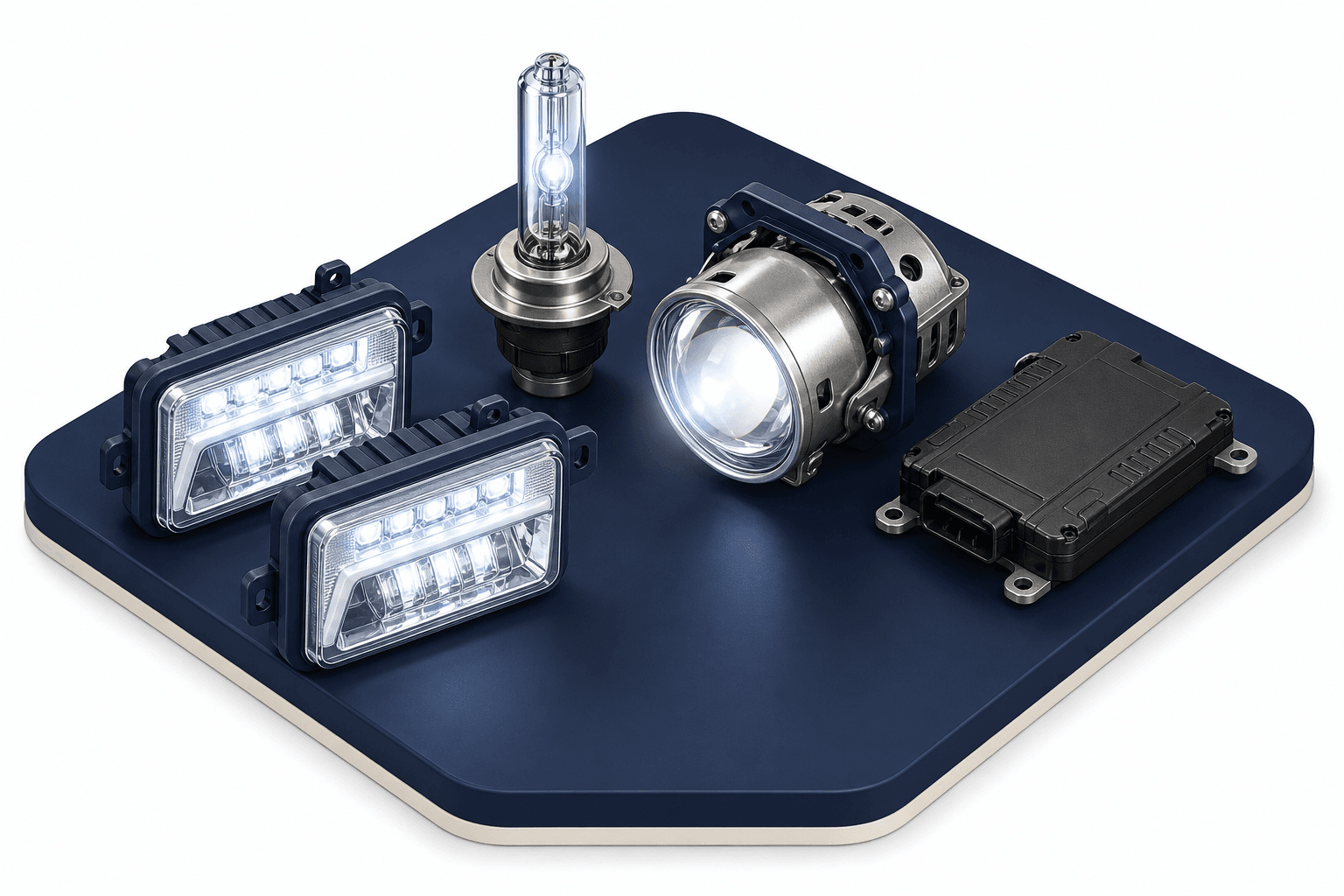
Key Takeaways
LED headlights tend to last longer and are roughly comparable in brightness to HID in real-world use. HID bulbs themselves are usually cheaper than LED bulbs, though full HID-compatible headlight assemblies can be expensive.
Both work well in projector housings, but LEDs are the more flexible option in reflector housings, provided you buy a bulb engineered for your car.
If you’re upgrading your car’s headlights, you’re likely choosing between HID and LED, here’s what actually separates them, beyond the marketing copy.
Both technologies have existed for years, but they’ve only recently become standard fitment in new vehicles.
What’s the difference between them, and which is better?
- The key differences between LED and HID headlights
- Whether they’re compatible with halogen housing
- Color temperature and what it means for visibility
- Which bulb is actually brighter
Key Differences Between LED And HID Headlights
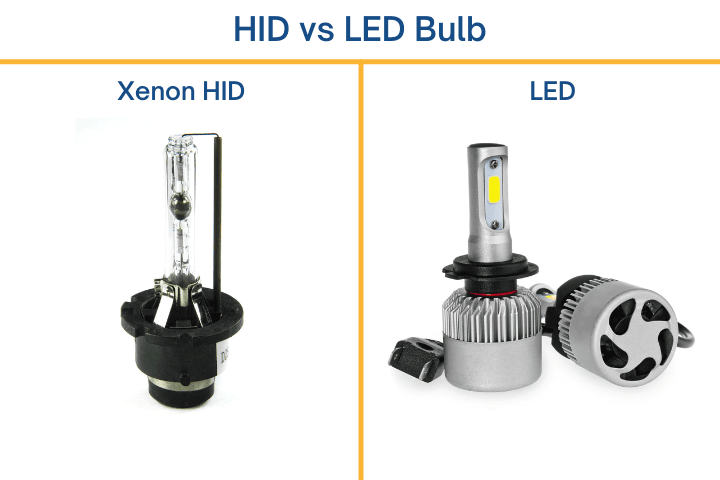
Before getting into the performance comparisons, it helps to understand how each technology works — this is the context that explains why they perform so differently.
LED stands for Light Emitting Diode. The light is entirely electronic — generated when a current passes through a semiconductor in the diode.
HID stands for High-Intensity Discharge. The bulb contains an inert gas (usually xenon) and two conductors. A current arcs between the conductors through the gas, producing a brilliant white light.
Two very different mechanisms, but both have earned a place in modern headlights. Here’s how they line up side-by-side.
HID vs LED Comparison Table
I’ve included halogen for reference, because the contrast with modern bulbs is the easiest way to see what LED and HID are bringing to the table.
| Criteria | LED headlights | HID headlights | Old halogen headlights |
|---|---|---|---|
| Brightness (effective lumens, per bulb) | ~1,500–3,000 | ~2,800–3,500 (OEM) | ~1,200–1,500 |
| Effective distance | 300m / 985ft | 300m / 985ft | 100m / 328 ft |
| Bulb lifespan | 30,000–50,000 hours (rated) | 2,000–8,000 hours | 450–1,000 hours |
| Energy use | 25 watts | 35 watts (+ ballast) | 55 watts |
| Lens-surface temperature | Cool | Warm | Hot |
| Ballast required? | No | Yes | No |
| Cooling required? | Yes (fan/heatsink) | No | No |
| Cost | $$$ | $$ | $ |
| Start-up time | Instant | 2–4s to light; up to 30s for full brightness | Near-instant |
| Wall-plug efficiency | ~30–50% | ~20–40% | ~10–20% |
Brightness
Both LED and HID headlights are dramatically brighter than old halogens, but raw lumen comparisons are messier than they look. OEM HID bulbs (D2S, D4S, etc.) put out around 2,800–3,500 lumens per bulb. Aftermarket LEDs are often marketed at 9,000–10,000+ lumens, but those figures are typically peak chip-level or per-pair numbers — real, in-housing output is closer to 1,500–3,000 lumens per bulb.
In practice, quality LEDs are competitive with or slightly brighter than HIDs, but treat inflated lumen ratings on the box with skepticism.
Effective distance
LED and HID both project usable light around 300 metres ahead, roughly triple the reach of a halogen bulb.
With that much extra brightness and reach, proper beam direction becomes critical. Misaimed or mismatched LED and HID setups can easily blind oncoming drivers.
Bulb lifespan
Quality LED headlights are rated for 30,000–50,000 hours on paper — often the entire lifetime of the car for a typical driver. In practice, real-world longevity depends on heat management and build quality, and the driver circuit (not the diodes themselves) is usually the first thing to fail. Cheap kits with poor cooling can fail in just a couple of years.
HIDs last 2,000–8,000 hours, depending on quality and how often you cycle them on and off. That’s many times longer than a halogen, but not lifetime-long.
Energy use
LEDs and HIDs both pull less raw wattage than halogens, but the difference at the battery is small — HIDs add a ballast that draws current of its own, and LED driver circuits aren’t free either. For most cars, the practical electrical impact is negligible.
Temperature
How each bulb manages heat differs significantly. Halogens radiate a large share of their input power as infrared heat directly through the lens. HIDs run hot inside the arc tube but release less radiated heat at the lens surface. LEDs run the coolest at the lens — but the diodes themselves generate substantial internal heat that has to be carried away with a fan or heatsink.
Why it matters: poor thermal management is the leading cause of premature LED failure, and the radiant heat from halogens is part of why older headlight assemblies tend to yellow and fog with age.
The winter trade-off: halogen headlights radiate enough heat through the lens to help melt snow and ice on the headlight. HID and LED both produce far less radiated heat at the lens, so accumulated snow can persist longer on the surface — though HID is somewhat warmer than LED in this regard. If you live somewhere with regular snowfall, this is worth knowing before committing to a full LED upgrade.
Installation requirements
HID and LED bulbs each add an installation step that halogens don’t require.
HID needs a ballast. A ballast generates the high-voltage ignition pulse that strikes the arc inside the bulb, then regulates current to keep the bulb running steady. Without it, the bulb would draw escalating current and fail almost immediately. Ballasts are usually palm-sized modules wired between the bulb and the car’s electrical system, and they’re included with most HID conversion kits.
LED needs cooling. Quality LED bulbs use a fan or heatsink to pull heat away from the diodes. Both add bulk behind the bulb base, so you may need to modify the dust cap that covers the headlight housing to make everything fit.
Cost
LED headlights are the most expensive option up front but last the longest. HID bulbs themselves are cheaper than premium LED bulbs, though a full HID-compatible headlight assembly can be costly if you’re switching over from a reflector housing.
If you don’t drive much at night, the lower up-front cost of HID may make sense. For heavy night drivers, the longer LED lifespan usually pays back the premium.
Start-up time
LEDs switch on instantly, like halogens. HIDs need 2–4 seconds to first strike the arc, then 20–30 seconds (sometimes up to a minute) to reach full color and brightness.
⚠️ Safety tip: switch HID headlights on a few seconds before you start driving so they’re at full brightness when you need them. Pulling out of a dark driveway with HIDs still warming up is a real visibility risk.
Energy efficiency
None of these bulbs are highly efficient — most input power becomes heat. Halogens convert roughly 10–20% of their power into visible light. HIDs sit in between. White automotive LEDs convert around 30–50%, which is why they still need active cooling.
The “90%+ efficient” figures sometimes quoted for LEDs come from lab-grade blue diodes; the phosphor-converted white LEDs used in headlights never come close to that in practice.
Are LED And HID Headlights Compatible With Halogen Housing?
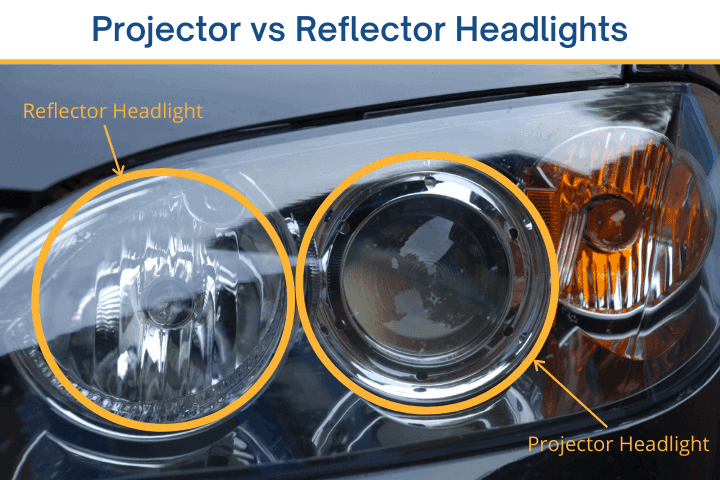
To answer this, you need to understand the two main housing types: reflector and projector.
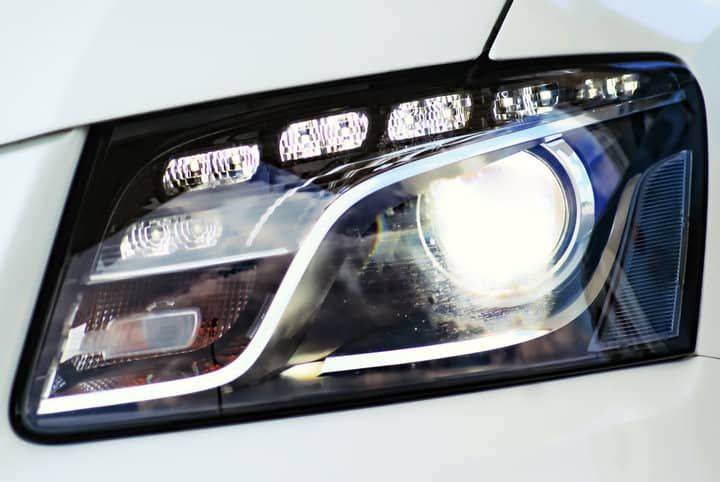
Halogen headlights use a reflector housing — the bulb sits inside a curved bowl that bounces light outward into a beam. Projector housings instead direct light through a lens, producing a tighter, more controlled beam with a sharp horizontal cutoff.
So can LEDs and HIDs be used in a halogen reflector housing?
HID in a halogen reflector housing: not recommended
An HID bulb will physically fit into many reflector housings, but the housing’s optics aren’t designed for an HID arc. The light source sits in the wrong place relative to the reflector geometry, so the beam scatters in all directions instead of forming a clean, controlled pattern. The result is severe glare for oncoming drivers and weaker forward illumination than a properly matched setup would deliver.
This setup also violates federal FMVSS 108 standards in the U.S., meaning HID-in-reflector retrofits aren’t street legal. To run HIDs properly, you generally need to swap in a headlight assembly designed (and DOT-approved) for HID bulbs — which is rarely cheap.
LED in a halogen reflector housing: sometimes
LEDs work well in projector housings and will sometimes work in reflector housings — but only if you buy a bulb specifically engineered for that purpose, with diodes positioned to mimic the filament location of the original halogen. A generic LED retrofit in a reflector bowl produces the same scattered, glaring beam pattern that HIDs do.
Use a compatibility checker for your make and model before buying, and look for kits that explicitly list reflector-housing support.
Why beam mismatch causes glare
In a housing not designed for the bulb, the light source sits in the wrong place relative to the reflector or lens. The sharp horizontal cutoff that keeps your beam below oncoming drivers’ eye level disappears, and scattered light spills upward. That’s bad for everyone — including you, because uncontrolled glare reduces contrast on the road ahead and your eyes can’t fully adapt.
A note on legality
Rules vary by jurisdiction. In the UK and EU, retrofitting non-type-approved HID or LED bulbs into a housing not designed for them is illegal and will fail an MOT or equivalent vehicle inspection. In the U.S., FMVSS 108 effectively prohibits these conversions, though enforcement varies by state. Check your local rules before retrofitting — and remember that even where enforcement is lax, your insurer may decline a claim if a non-compliant headlight setup is implicated in a collision.
What About Color Temperature?
Color temperature, measured in Kelvin (K), describes the visible color of the light — warmer (yellower) at lower numbers, cooler (bluer) at higher ones. It’s one of the most visible differences between halogen, HID, and LED in real-world use.
- Halogens sit around 3,000–3,500K (warm yellow-white).
- OEM HIDs are typically 4,200–5,000K (white with a slight blue tint).
- Most LED headlight bulbs target 5,000–6,500K (cool white, closer to daylight).
Higher isn’t better. Bulbs marketed at 8,000K or above shift into the blue-purple range, and they actually reduce real-world visibility: blue light scatters more in rain, fog, and snow, and the human eye is less sensitive to it than to white light around 5,000–6,000K. Stick to 5,000–6,000K for the best balance of perceived brightness and visibility in poor weather.
Are LED Headlights Brighter Than HID?
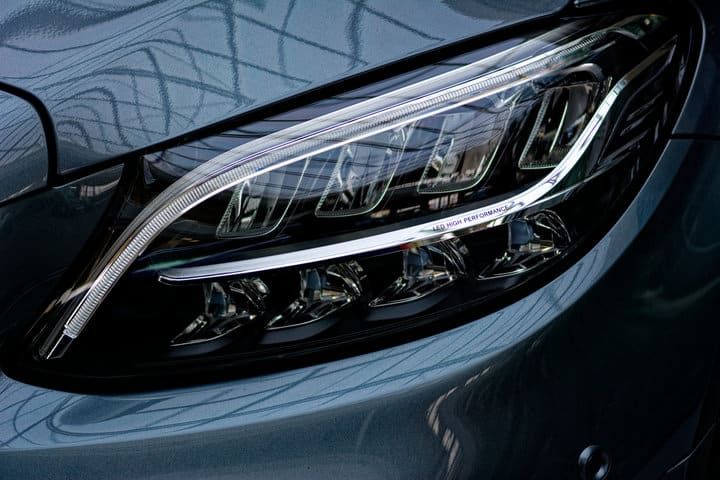
On paper, aftermarket LEDs often claim 9,000–10,000+ lumens while HID is marketed around 8,000. In reality, both numbers are inflated. Real, in-housing output is closer to 1,500–3,000 lumens for quality LED bulbs and 2,800–3,500 lumens for OEM HID. Premium LEDs are roughly comparable to HID, occasionally a bit brighter — not dramatically so.
More importantly, raw lumen counts don’t tell you how well a bulb illuminates the road. Beam pattern matters more than total light output. A bulb that puts 2,500 well-directed lumens onto the road will outperform one that scatters 5,000 lumens everywhere — including into the eyes of drivers in the other lane.
Look for bulbs with a sharp horizontal cutoff line and a beam pattern matched to your housing. A well-aimed LED in a compatible housing will feel brighter and safer than a higher-lumen HID in a mismatched setup, even if the spec sheet says otherwise.
Final Words
LED and HID headlights are both meaningful upgrades over halogen, and the right choice depends on how you drive and what your car’s housing supports. The headline trade-offs: LEDs last longer and run cooler at the lens; HIDs are cheaper bulb-for-bulb but slower to warm up and harder to retrofit legally; both are far brighter and longer-ranged than halogen, and both demand careful housing compatibility to avoid blinding glare.
For most drivers, my recommendation is LED. The longer lifespan, instant start-up, and wide availability of housing-specific bulbs make them the more flexible choice — and the up-front cost is usually justified by how long they last.
HIDs make the most sense if your car already has a projector housing built for them and you want the brightest possible output from a single bulb. They’re cheaper bulb-for-bulb than premium LEDs, but a full HID-compatible assembly retrofit is expensive.
Whatever you choose, prioritize beam pattern over raw lumens, stick to color temperatures in the 5,000–6,000K range, and confirm the conversion is legal where you drive before committing.