Why Do LED Bulbs Say For Off-Road Use Only?
That "DOT-approved" stamp on your LED retrofit kit isn't a federal certification — FMVSS 108 has no approval pathway for bulbs dropped into existing halogen housings. The distinction means you could be driving illegally while believing you've done everything right.
 Eugen
EugenEugen Nikolajev
Creator of LED Lighting Info
Hi, I am Eugen. I was always one of those kids who had all sorts of weird lighting gadgets for every occasion.
Now, I want to share my knowledge and experience about lighting with you on LED Lighting Info.
Read my editorial standards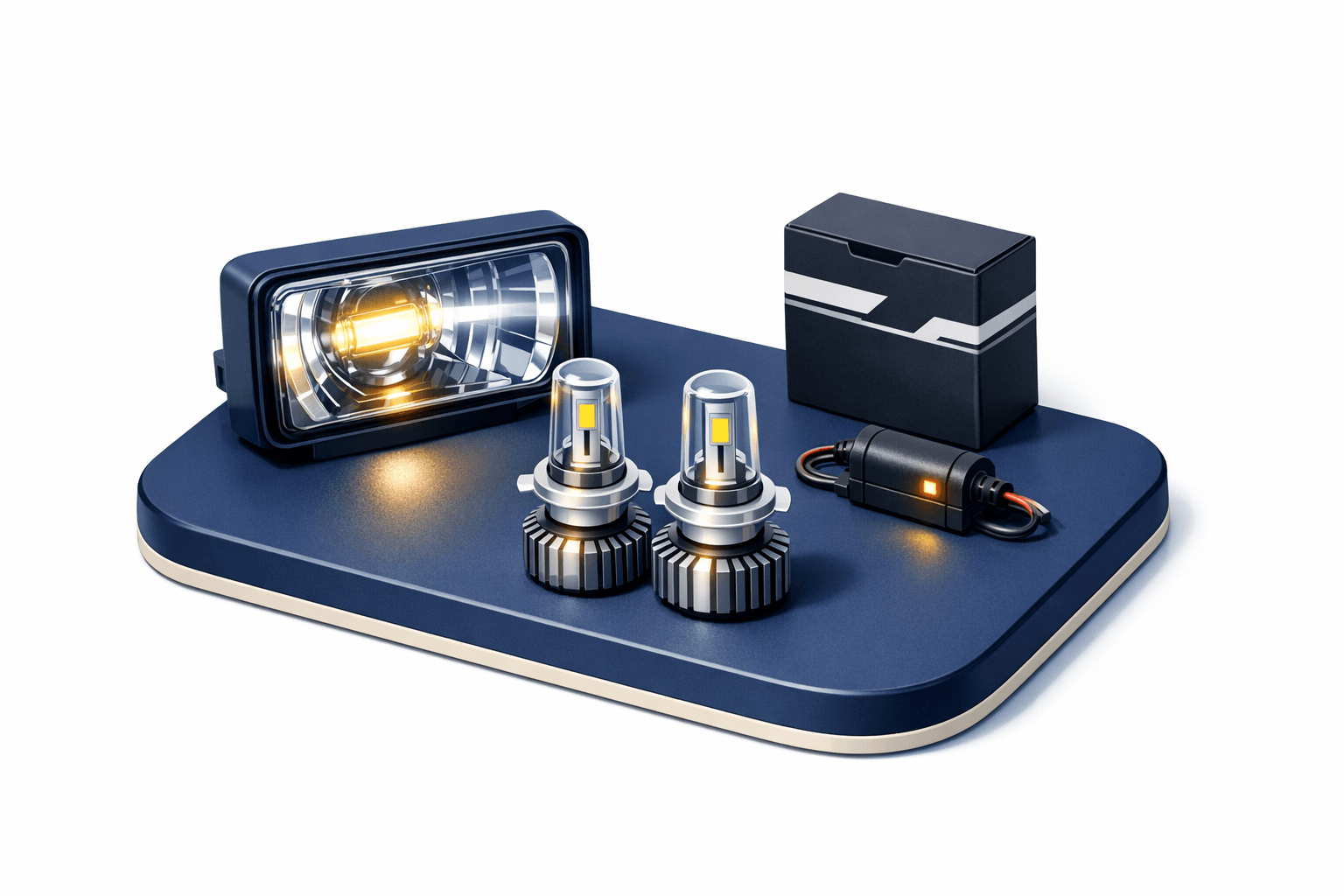
Key Takeaways
LED bulbs labeled "off-road use only" haven't been certified for road use — they may be too bright at the wrong points in the beam, fall outside the legal white-light range, or simply have never been submitted for certification. Using them on public roads is illegal in the US and can earn you an equipment-violation citation.
LED headlights last up to five times longer than halogens — but many of the popular upgrade kits sold online are technically illegal the moment you drive them onto a public road. That's where the "For off-road use only" label on the packaging comes in.
In this article I'll cover:
- What "off-road use only" actually means on LED packaging
- The three reasons these bulbs are illegal for road use
- The critical retrofit-bulb vs. complete-assembly distinction
- How to spot a road-legal bulb on the shelf
- What happens if you get pulled over
What "Off-Road Use Only" Actually Means
A lot of LED lighting manufacturers print "For off-road use only" on their packaging. It's a catch-all disclaimer that means the product hasn't been certified for use on public roads — and selling it for off-road use shifts legal responsibility from the manufacturer to the buyer.
"Off-road" doesn't only mean driving over untamed land. It also covers racing on a private track, building a show car for static display, or running auxiliary lighting on a vehicle that never leaves private property.
You'll see this label most often on auxiliary lighting — roof-mounted light bars, A-pillar pod lights, ditch lights, and similar accessories — rather than on plain headlight replacement bulbs. Some of those bars are genuinely useful for trail driving, while others are purely cosmetic. Don't assume that a bulb labeled off-road only will help you see better in difficult conditions; check what it was actually designed for.
Why Off-Road LEDs Are Illegal On Public Roads
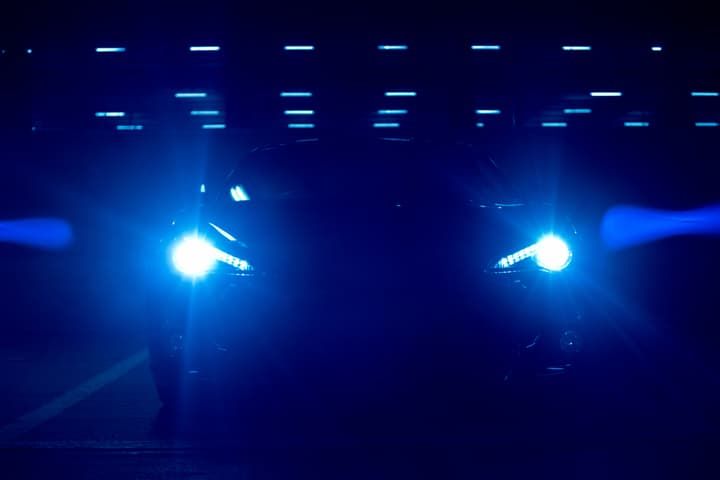
There are three main reasons an LED bulb may be marked off-road only. Most off-road labels boil down to one or more of these.
Reason 1: Excessive or Misdirected Brightness
An off-road LED designed for a light bar can throw far more light than a road-legal headlight, often in a flood pattern with no controlled cutoff. On a public road, that's dangerous — even a half-second of dazzle from oncoming glare can send a driver out of their lane.
In the US, headlight intensity is governed by Federal Motor Vehicle Safety Standard 108 (FMVSS 108). FMVSS 108 doesn't set a single brightness ceiling — it caps luminous intensity (measured in candela) at multiple individual test points across the beam pattern, and the limits vary by beam type and zone. Upper beams can reach roughly 75,000 candela at the brightest point, while lower beams are held to much lower values right above the cutoff line to prevent glare to oncoming drivers.
You'll often see lumens quoted on bulb packaging, but lumens describe the bulb's raw light output before any optics shape the beam — and FMVSS 108 doesn't regulate raw lumens at all. A complete LED headlight assembly can put out well over 4,000 lumens at the source and still be road-legal, because the housing controls where that light goes. Treating a flat lumen number as a legality threshold is a common myth.
Off-road, the calculus changes — there are no oncoming drivers to dazzle, just terrain to see. That's the environment those bulbs were actually designed for. You can read more on how aftermarket LED brightness affects other drivers for a closer look at the glare problem.
Reason 2: Non-Compliant Color Temperature
Color temperature is measured in Kelvins (K). For reference, a candle flame sits around 1,800K, a warm halogen around 3,000K, and midday sunlight around 5,500K. Most road-legal LED headlights fall between roughly 4,000K and 6,000K.
FMVSS 108 doesn't specify a Kelvin number directly — it requires headlight light to fall within a defined "white" zone on the CIE chromaticity diagram. That permits warm white at the lower end (around 4,300K, the legacy HID color point) up through the cool whites that most modern factory LEDs produce.
Bulbs marketed at 8,000K to 12,000K shift toward blue or violet — they fall outside the white zone, aren't road-legal, and don't actually improve visibility. The blue tint scatters more in fog and rain, so the cosmetic upgrade comes at the cost of seeing less. Yellow-shifted light sits at the other end of the white zone and is also legal, which is why fog lights have traditionally leaned warm.
Reason 3: No Certification Pathway
The third reason is the most important — and the one most commonly misunderstood. There's a critical distinction between two product categories:
- LED retrofit bulbs — sold to drop into a halogen housing — are not federally legal in the US. The original housing optics were designed around a halogen filament, not an LED chip, and FMVSS 108 has no certification pathway for swapping the light source inside an existing assembly. "DOT" stamps printed on retrofit-bulb packaging are essentially marketing claims, not federal certifications.
- Complete LED headlight assemblies — whether installed at the factory by the carmaker or sold as DOT-compliant aftermarket replacement units engineered as a single optic — are fully legal. Most new vehicles sold in the US today ship with factory LED headlights.
If your car came with LED headlights from the factory, you're fine. If you bought a kit to swap LED bulbs into your old halogen housings, those almost certainly don't meet FMVSS 108 even if the box says "DOT-approved."
Some drivers also install off-road LED bulbs in fog or auxiliary lamp positions on the assumption that those slots aren't regulated. They are — fog lamps fall under FMVSS 108 too, and many states restrict when and how fog lamps may be used (often only in low-visibility conditions, often required to be off when high beams are on). The same retrofit-vs-assembly logic applies. Don't treat fog-lamp positions as a loophole.
Regulations are also evolving. In 2022, NHTSA finalized a rule allowing adaptive driving beam (ADB) headlights in the US — a category of intelligent LED systems that can selectively dim portions of the beam to avoid blinding oncoming drivers. The headlight rules aren't frozen, and the legal LED category is steadily widening.
How To Tell If A Bulb Is Road-Legal
Before buying any LED headlight upgrade, check the packaging for the following:
- DOT marking — A genuine DOT mark indicates the manufacturer is self-certifying compliance with FMVSS 108. Be skeptical of "DOT" claims on retrofit bulbs specifically; the certification pathway only exists for complete assemblies.
- SAE designation codes — Codes like H11, H7, HB3, HB4, or 9005 / 9006 indicate the lamp type and bulb interface defined by SAE standards. The presence of a code is a baseline; it doesn't guarantee compliance on its own.
- Explicit FMVSS 108 compliance language — Reputable manufacturers state compliance directly. Vague phrasing like "meets all standards" without naming FMVSS 108 is a yellow flag.
- Color temperature in the white range — Stick to roughly 4,000K–6,000K. Anything labeled 8,000K and up is decorative, not road-legal.
- The absence of "For off-road use only" — If that disclaimer is anywhere on the box, the manufacturer is telling you it's not road-legal.
If your headlights use a reflector-style housing, also check whether an LED bulb is appropriate at all — see our guide to LED headlights in reflector housings and the projector housing equivalent.
What Happens If You Get Pulled Over
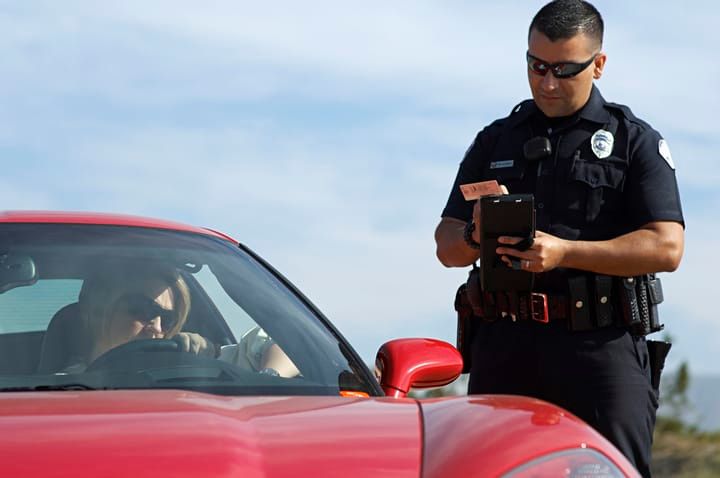
Run off-road LED bulbs on a public road and an officer can absolutely pull you over and write you up. Exactly what happens next depends on your state — terminology and procedure vary widely — but most equipment-violation outcomes fall into one of two categories.
"Fix-It" Ticket (Correctable Violation)
In many states, a non-compliant headlight is a correctable violation — sometimes called a "fix-it ticket." The officer notes the equipment problem and gives you a window to replace the bulbs and submit proof of correction (often a signature from a local police station, a court clerk, or a certified mechanic). Once you provide proof, the citation is dismissed or reduced to a small administrative fee. In some states, equipment violations are also "secondary offenses" that an officer can only cite if you were already stopped for something else.
Notice To Appear (Standard Citation)
If your state doesn't offer a fix-it option, or if you ignore the correction window, you'll get a standard citation with a fine due regardless of whether you replace the bulbs. Equipment-violation fines vary by jurisdiction but typically run $150 to $300 for a base citation, climbing higher in stricter states (Hinds County, Mississippi sets improper-equipment fines at $208.50 as of 2025; New York equipment violations can reach $450 for faulty brakes or tires and $1,000 for illegal exhaust). The violation can also be added to your driving record.
The bigger long-term cost is usually insurance. A single moving violation on your record can add roughly $580 per year to your premium for several years — often dwarfing the fine itself. Also worth knowing: if non-compliant headlights contribute to an accident, a sharp insurance adjuster or opposing attorney may use that to complicate a claim or warranty dispute.
Final Words
The "For off-road use only" label exists for three specific reasons: the bulb is too bright at the wrong points in the beam, its color temperature falls outside the regulated white zone, or it's never been certified to FMVSS 108 in the first place. The retrofit-bulb-vs-complete-assembly distinction is what trips most people up — factory and DOT-compliant LED assemblies are fully road-legal, while drop-in LED replacements for halogen housings generally are not, regardless of what their packaging promises.
Before you buy any LED headlight upgrade, look for an explicit FMVSS 108 compliance claim, a recognized SAE designation code, and a color temperature in the 4,000K–6,000K range — and walk away from anything that says "For off-road use only" on the box if you intend to drive on public roads.