
What Light Bulbs Are Best For Chandeliers?
Chandeliers use a smaller E12 candelabra screw base, not the E26 in your floor lamp — and buying the wrong size is the single most common chandelier bulb mistake.
 Eugen
EugenEugen Nikolajev
Creator of LED Lighting Info
Hi, I am Eugen. I was always one of those kids who had all sorts of weird lighting gadgets for every occasion.
Now, I want to share my knowledge and experience about lighting with you on LED Lighting Info.
Read my editorial standards
Key Takeaways
Most chandeliers use thinner, candle-shaped bulbs (B, CA, or C) on an E12 candelabra base, though some modern fixtures take classic A-shaped bulbs. You calculate total wattage from room size and divide across sockets.
LED is the long-term winner, halogens are being phased out, but they need an LED-rated dimmer to dim properly. Color and finish (clear vs. frosted) are mostly down to taste.
When lighting a room with a chandelier, choosing the right fixture is only half the battle. The most common chandelier mistake I see is people buying bulbs with the wrong base — chandeliers use a smaller E12 candelabra screw, not the standard E26 medium base — followed closely by exceeding the fixture's wattage label.
So how do you choose the right bulbs for your chandelier?
Here's the short version of what I'll cover:
- Shape: candle-style B, CA, or C bulbs on E12 bases fit most chandeliers
- Bulb type: LED is the long-term winner — halogens are being phased out
- Wattage: aim for roughly 20–25 lumens per square foot, split across all sockets
- Finish: frosted softens glare; clear shows off filaments and crystal
- Color: 2,700–3,000K for warm, inviting light in most rooms
Choosing The Light Bulb Shape For A Chandelier
The size and style of your chandelier dictates the shape of bulb you can use.
Most compact chandeliers pair best with candle-shaped bulbs — described as B (blunt tip), CA (bent/flame tip), or C (cone/flame tip). These almost always sit on an E12 "candelabra" screw base, which is noticeably smaller than the E26 medium base used by standard household A19 bulbs.
Check the fixture before you buy — pulling out an old bulb and reading the base size off the metal cap is the fastest way to avoid a frustrating return trip. E12 and E26 are not interchangeable.
If you have a more modern chandelier that uses only 3–4 bulbs over a larger space, you may instead be working with classic A-shaped bulbs on an E26 base — the same shape that hangs in a pendant fixture.
When in doubt, buy one or two cheap bulbs in different sizes and check how they look on the fixture. Make sure they fit physically too — if your chandelier has multiple sockets close together, fatter bulbs may not sit next to each other without touching.
LED vs. Halogen: Which Bulb Type To Buy
I'm putting this decision first because it affects every other choice — wattage planning, dimmer compatibility, and bulb availability all change once you pick a technology.
Older chandeliers were originally designed for incandescent and halogen bulbs, but both are now being phased out. The U.S. Department of Energy's August 2023 efficiency rule (45 lumens per watt minimum) effectively ended sales of standard incandescent and traditional halogen bulbs in the U.S., and the EU completed its halogen phase-out in 2018–2023. For any new chandelier purchase, LED is the recommended long-term choice.
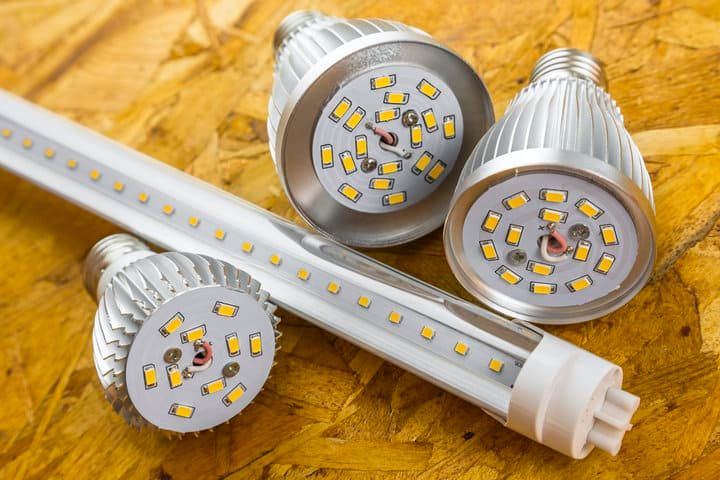
LEDs use roughly 75–85% less energy than halogen — often a fifth to a tenth of the wattage for the same light output. A 40-watt halogen candelabra is typically replaced by a 4–5W LED. LED bulbs also fit the same sockets as halogen ones, provided you buy the right shape and base.
| LED | Halogen | |
|---|---|---|
| Energy use | ~4–5W for a 40W equivalent | ~40W per bulb |
| Lifespan | 15,000–25,000 hours | 1,000–2,000 hours |
| Dimmer compatibility | Needs LED-rated dimmer + dimmable bulb | Works with most traditional dimmers |
| Enclosed fixtures | Only if labeled "Enclosed Fixture Rated" | Designed for warm, enclosed conditions |
| Heat output | Cool to the touch | Runs very hot |
| Upfront cost | Higher | Lower |
| Availability | Widely available | Phased out in U.S. (2023) and EU (2018–2023) |
Enclosed fixtures need a special LED rating
Halogens and older incandescents tolerated heat — LEDs don't. In an enclosed glass globe or shade, trapped air can cook a standard LED and dramatically shorten its lifespan.
Look for "Enclosed Fixture Rated" (or "Suitable for Enclosed Fixtures") printed on the LED packaging. Bulbs with this rating are built with heat sinks and components designed to survive trapped-air conditions; non-rated LEDs in the same fixture will overheat and fail prematurely.
Dimmers need to match
If your chandelier is on a dimmer, this matters. LED bulbs paired with a traditional incandescent (leading-edge / TRIAC) dimmer often flicker, buzz audibly, or dim unevenly — especially at the low end. The driver–dimmer mismatch can also shorten bulb lifespan over time.
You need two things for smooth dimming:
- An LED-compatible dimmer — usually a trailing-edge (ELV) or specifically LED-rated model
- Bulbs explicitly labeled "Dimmable" (or marked with a dimmer-compatible symbol) on the box — not all LEDs are dimmable, and they look identical on the shelf
Replacing the dimmer is a worthwhile one-time cost. With LED-rated hardware, the bulbs last for many years and the electricity bill drops sharply.
How To Select The Right Wattage Bulbs For A Chandelier
Wattage planning sounds complicated, but a simple rule of thumb gets you close. Here's how to size the bulbs for your room:
- Measure the room's square footage (length × width).
- Pick a multiplier: 1.5 for ambient/general use (living room, dining room), or 2.5 for task lighting (kitchens, reading areas).
- Multiply the two for your total target incandescent-equivalent wattage.
- Divide that total by the number of bulb sockets in the chandelier.
- On the bulb packaging, match that per-socket figure to the "equivalent wattage" printed on the box (e.g., a 4W LED labeled "40W equivalent").
Worked example: a 15 × 10 ft dining room is 150 sq ft. Multiplied by 1.5, that's 225 watts of total equivalent output. A 6-socket chandelier would need bulbs rated around 40W equivalent each (typically 4–5W of actual LED draw).
If the box lists only lumens
Modern LED packaging often leads with lumens (actual light output) rather than equivalent wattage. As a rough guide for translating:
- 450 lumens ≈ 40W equivalent
- 800 lumens ≈ 60W equivalent
- 1,100 lumens ≈ 75W equivalent
If you want to plan in lumens directly, aim for roughly 20–25 lumens per square foot of ambient light, or 30–40 lm/sq ft for dining rooms and 70–80 lm/sq ft for kitchen task lighting.
Check the fixture and dimmer limits
Two ceilings you cannot exceed:
- The fixture's maximum wattage — printed on a label on the socket or wiring. The total of all bulbs must stay below this number.
- Your dimmer's load rating — commonly 150W, 300W, or 600W. LED-rated dimmers often derate sharply for LED loads, sometimes to about 1/10 of the marked maximum, so check the LED-specific limit on the dimmer.
Standard mechanical wall switches are rated in amps (typically 15A or 20A), which gives plenty of headroom for any chandelier — they're not the limit to worry about.
Light Quality: Finish, Color Temperature, and CRI
Shape, wattage, and bulb type cover the practical compatibility. Three remaining choices — finish, color temperature, and color rendering — shape how the chandelier actually looks and feels.
Clear vs. frosted
Next, you need to decide whether you want clear or frosted bulbs for your chandelier.
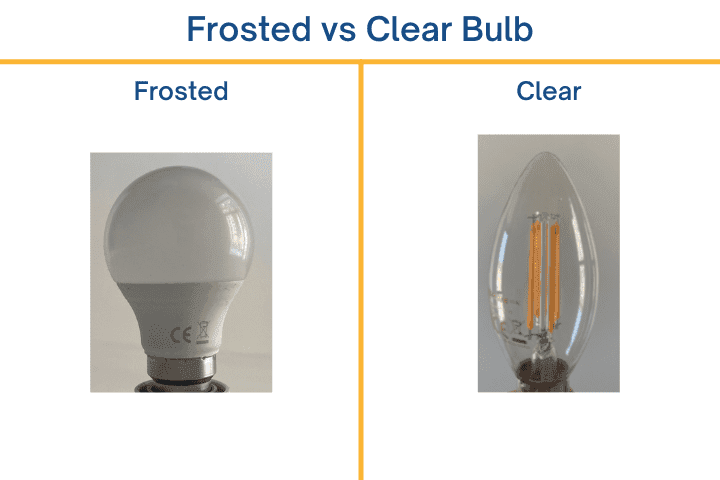
Frosted bulbs have an opaque casing that hides the filament and diffuses the light. The softer glow is gentler on the eyes and lets you appreciate the fixture without glare — a good default for most chandeliers.
Clear (transparent) bulbs let more light through, which helps in rooms where task lighting matters, like a kitchen. They also pair well with retro-modern or chrome chandeliers, where you want to see the filament. Modern LED bulbs can mimic that look — you can buy old-fashioned filament-style LEDs that show off the glowing element through clear glass.
Both finishes work — let the chandelier style and lighting purpose decide.
Color temperature
Color temperature is measured in Kelvins (K). Residential bulbs typically run from about 2,200K up to 6,500K. Lower numbers look more yellow and warm; higher numbers shift toward neutral and then cool, blue-tinged white.
For most chandeliers, you'll stay at the lower end of the range. 2,000K is candlelight — a deep amber tone that suits traditional chandeliers where the fixture is more about ambience than brightness. Something closer to 2,700–3,000K is a soft/warm white that feels brighter than candlelight while still flattering most interiors — this is the sweet spot for dining rooms and living rooms. If you want a truly neutral or "pure" white, look at 3,500–4,000K, but it can feel clinical in a chandelier setting.
Don't skip CRI
CRI (Color Rendering Index) measures how accurately a bulb shows colors compared to natural light, on a 0–100 scale. For a chandelier over a dining table or in a decorative space, look for CRI 90 or above on the packaging — it makes a visible difference in how food, skin tones, and finishes look. Most budget LEDs sit around 80; the step up to 90+ is worth the small price difference for any fixture you'll be eating or entertaining under.
Quick-Reference Checklist
Before you buy, run through these five decisions:
- Shape and base — candle-style B, CA, or C on an E12 base for most chandeliers; A-shape on E26 for larger modern fixtures.
- Bulb type — LED for new purchases; check for "Enclosed Fixture Rated" if your chandelier uses globes.
- Wattage — total target = square footage × 1.5 (ambient) or 2.5 (task), divided across sockets, kept under the fixture's max.
- Finish — frosted to diffuse; clear (or filament-style) to show off the bulb and fixture.
- Color and quality — 2,700–3,000K for warm light, CRI 90+ for dining and decorative spaces, "Dimmable" label if you're on a dimmer (paired with an LED-rated dimmer).