
Are LED Lights Safe For Dogs?
Dogs' flicker fusion frequency sits at 70–80 Hz, so a cheap LED driver can look perfectly steady to you while visibly strobing to your dog. That invisible stress — not the bulbs themselves — is the real thing to fix.
 Eugen
EugenEugen Nikolajev
Creator of LED Lighting Info
Hi, I am Eugen. I was always one of those kids who had all sorts of weird lighting gadgets for every occasion.
Now, I want to share my knowledge and experience about lighting with you on LED Lighting Info.
Read my editorial standards
Key Takeaways
LED lights are generally safe for dogs. Keep cables out of reach, choose flicker-free bulbs to avoid stress that’s invisible to humans but visible to dogs, and avoid bright blue light near bedtime.
LED lights are generally safe for dogs — but a few specific risks are worth knowing about. The most common are exposed cables, cheap drivers that flicker invisibly to humans, and bright blue light near bedtime.
I’ve lived with dogs around LED setups for years, and the fix for almost every issue is the same: buy quality bulbs and tuck cables out of reach. The rest is fine-tuning.
Here’s what this article covers:
- Why LED flicker is more stressful for dogs than humans
- Which light colors disrupt your dog’s sleep — and which ones calm them
- How to install LED strip lights safely around chewing dogs
- Whether LEDs emit harmful UV or heat for pets
Are LED Lights Bad For Dogs?
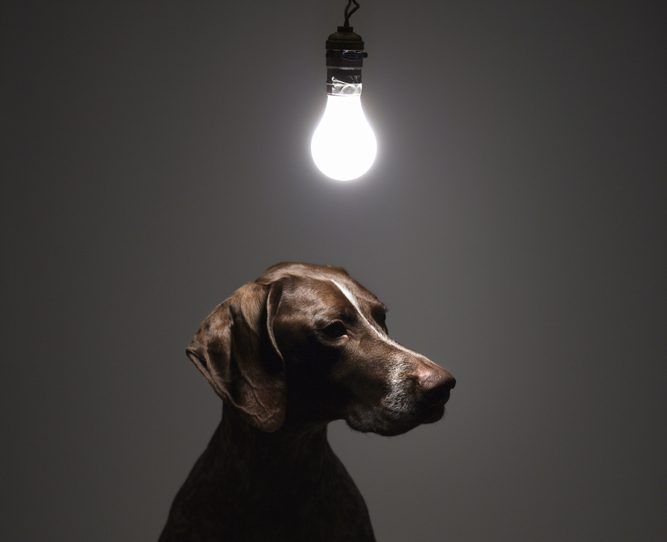
LED lights are usually safe for dogs. They generate far less heat than incandescent or halogen bulbs — LED bulb surfaces typically reach 60–80°C versus 170°C+ for incandescent — so the burn risk on accidental contact is much lower. High-power LEDs and strips can still get warm enough to cause minor discomfort, though, so don’t assume zero heat.
The two real risks are exposed cables and bright or saturated blue light near bedtime. Both are simple to manage. Don’t leave wires within reach where a dog could chew them, and avoid harshly bright bulbs in rooms where the dog rests.
Pay particular attention to LED lights that a dog can reach.
If a dog chews the cable powering an LED light (or even an LED strip itself), it’s unlikely they’d suffer fatal electrocution. However, they could get a nasty burn on their mouth, and the current can disrupt other bodily functions. The most serious complication is noncardiogenic pulmonary edema — fluid build-up in the lungs — where veterinary literature reports survival rates of 40–85% depending on severity and how quickly treatment is given.
Do LED Strip Lights Affect Dogs?
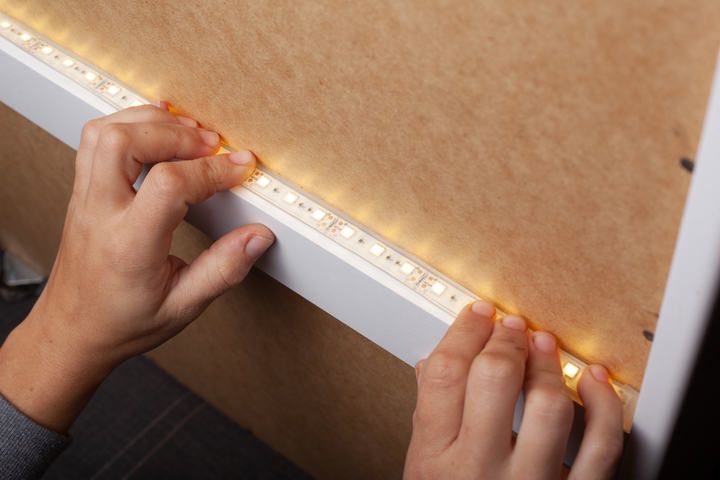
Good quality LED strip lights are safe for dogs as long as you install both the strips and their wires out of reach. There’s no reason you can’t add LED strip lights to your home if you’re a dog owner.
A popular spot for LED strip lights is the underside of kitchen cabinets, providing a stylish glow on the floor. But at this height, both the strip and its power cable are within reach of most dogs.
Use this checklist to keep strips secure:
- Pin strips flush to the surface so no loose sections hang down (see how to pin strips to a cabinet).
- Run the cable along edges and tuck the transformer behind furniture or inside a cabinet.
- Secure every cable run from outlet to fixture — no trailing wires.
- Mount strips above the dog’s standing reach where possible.
- For long runs in dog-accessible areas, use aluminium channels or profiles to make the strips chew-resistant.
Long strips also pose an entanglement risk. A bored dog tugging on a loose section could pull it down and get tangled — especially if you’re not home. Tug-test every installed run before leaving the dog alone with it.
Can LEDs Hurt Dogs’ Eyes?

Cheap LED lights can stress a dog’s eyes because they may flicker at frequencies humans can’t see but dogs can. Lights that are too bright also cause discomfort, and the wrong color light can disrupt sleep — covered in the color section below.
The single most important fix is buying high-quality bulbs from reputable brands. Combine that with sensible color choices and a sensible brightness level.
LED Lights Flickering
Humans’ critical flicker fusion frequency — the rate at which flickering light appears steady — is around 60 Hz. Dogs’ flicker fusion frequency is around 70–80 Hz, meaning a cheap LED driver running at 60–75 Hz can look perfectly steady to you while strobing visibly to your dog.
A 2025 study in Applied Animal Behaviour Science found measurable behavioral differences in shelter dogs under fluorescent versus LED lighting, confirming that lighting quality affects canine wellbeing — not just human eyes.
What to look for in a flicker-free LED:
- “Flicker-free” certification on the packaging or product page.
- High-frequency PWM drivers, ideally above 1 kHz.
- CRI of 90 or higher for accurate color rendering.
- Established brands rather than the cheapest unbranded strips.
When in doubt, switch off LED lights when you leave the house — particularly older or budget-tier strips you haven’t verified as flicker-free.
Do LEDs Emit Harmful UV?
Standard household LEDs emit negligible UV — significantly less than incandescent or halogen bulbs. They’re not a UV risk for your dog’s eyes or skin under normal residential use. The only exceptions are specialty UV LEDs (used for curing, sterilization, or reptile habitats), which should never be installed in shared living spaces.
How Bright Is Too Bright?
A reasonable rule of thumb: in spaces where dogs rest, keep ambient lighting under 400–500 lumens. For comparison, a typical 60W-equivalent LED bulb produces around 800 lumens. If the room feels harshly bright to you, it’s almost certainly too bright for a dog — their pupils are larger and more adapted for low light. Use dimmable bulbs or lower-output fixtures in bedrooms, crates, and quiet corners.
How Color Affects Your Dog
Dogs are dichromats, with two cone types most sensitive to blue-violet (~429 nm) and yellow-green (~555 nm) wavelengths. Humans, by contrast, are trichromats. So dogs see fewer colors than we do, primarily distinguishing shades along a blue-yellow axis. Reds appear as a dark brownish-grey, greens look yellowish or muted, and dogs frequently confuse the two — the classic “red ball on green grass” camouflage problem.
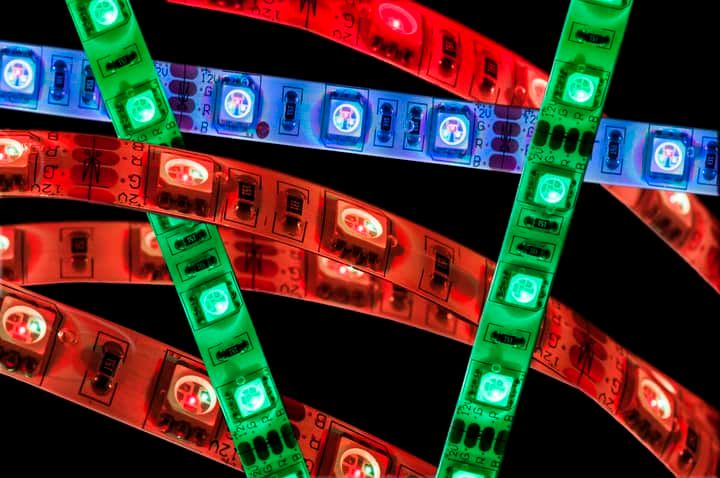
Many LED strip lights — especially those marketed for ambient or decorative use — are RGB and let you choose from over 16 million color shades. That’s a useful tool for setting the right tone for your dog, not just your décor.
Here’s how the most common LED colors actually land for a dog:
| Color | How Dogs Perceive It | Behavioral Effect |
|---|---|---|
| Bright/saturated blue | Visible — strong on dogs’ blue cone | Daytime alertness; suppresses melatonin and disrupts sleep at night |
| Pastel/sky blue | Visible but muted | Calming during the day; can lower heart rate |
| Yellow | Visible — the most distinct color for dogs | Calming, especially warm yellow tones |
| Red | Appears as dark brownish-grey | Soothing; least likely color to disrupt sleep |
| Green | Appears yellowish or muted | Neutral; often confused with red |
| Bright white / daylight | High brightness, mimics sunlight | Stimulating; disrupts circadian rhythm if used at night |
Blue Light And Sleep
Bright or saturated blue (and bluish-white) light suppresses melatonin and disrupts sleep cycles in dogs and humans alike. Long-term sleep disruption can affect mood and behavior.
There’s a nuance worth understanding: pale, soft blue tones during the day are different. Research suggests dogs’ heart rates can drop when exposed to soft daytime blue, and dogs spend more time in spaces lit by yellow and blue compared to red or green. The takeaway isn’t “all blue is bad” — it’s “avoid bright, saturated blue near bedtime.”
What Color Light Is Calming For Dogs?
Warm yellow light is the most soothing choice, especially dimmer warm tones close to bedtime. Red light is also a strong evening pick — since dogs perceive it as a muted dark tone, it’s the least likely color to disrupt sleep.
Soft pastel blue can relax dogs during daylight hours, but switch to warm tones in the evening. Bright whites are stimulating and best reserved for active spaces, not areas where the dog rests.
LED Light Therapy Is A Different Thing
“LED light therapy” or “red light therapy” for dogs is a separate topic from household LED lighting. Therapy devices emit narrow-band wavelengths (typically 630–680 nm or 800–880 nm) at controlled doses, and are used clinically for joint pain or wound healing. Standard residential LEDs aren’t powerful or targeted enough to deliver therapeutic effects — and won’t function as therapy devices, no matter what the marketing claims.
Special Considerations For Anxious And Photosensitive Dogs
If your dog has epilepsy or a known photosensitive condition, flicker isn’t just an annoyance — it could potentially trigger seizures. Stick to flicker-free, high-frequency-driver LEDs in any room your dog spends time in, and ask your vet whether specific lighting changes make sense for their case.
Anxious dogs often do better with steady, warm lighting rather than dynamic RGB color shifts. If you use smart bulbs, set a static warm-white scene during quiet hours and skip the color-cycling effects.
Final Takeaways
Quick recap of the points worth remembering:
- LEDs run cool relative to traditional bulbs, but high-power strips can still warm up — keep them out of reach.
- Buy flicker-free, high-CRI LEDs to avoid stress that’s invisible to human eyes but visible to dogs.
- Use warm yellow or red tones in the evening; avoid bright blue or white near bedtime.
- Install strips flush to surfaces and secure every cable. Entanglement and chewing are the real risks, not the bulbs themselves.
- For dogs with epilepsy or photosensitivity, prioritize flicker-free certification and consult your vet.
If you’re planning a strip install, how to install LED strips on the ceiling walks through the step-by-step. Curious about other pets? Can You Use LED Bulbs For Bearded Dragons? covers reptile-specific lighting needs.