LED Flood Light vs Regular Bulb: 6 Main Differences
A 4000-lumen flood on a small porch won't feel bright — it'll feel harsh. Matching a floodlight to your space is as much about scale as lumens.
 Eugen
EugenEugen Nikolajev
Creator of LED Lighting Info
Hi, I am Eugen. I was always one of those kids who had all sorts of weird lighting gadgets for every occasion.
Now, I want to share my knowledge and experience about lighting with you on LED Lighting Info.
Read my editorial standards
Key Takeaways
The main difference between LED flood lights and regular bulbs is that LED floodlights are designed to illuminate large spaces, often outdoors, or commercial locations.
They are bigger, have wider beam angles, and generate more light.
Floodlights are some of the brightest bulbs you can buy — designed to emit light over a wide area and 'flood' a space with brightness. But what actually separates an LED floodlight from a regular bulb, and can you use one in a regular socket?
In this article, I'll take you through:
- The main differences between a floodlight bulb and a standard light bulb
- Whether you can use floodlights in indoor light sockets
- Other specs to check before buying — color temperature, lifespan, dimmability, and IP rating
6 Differences Between A Floodlight Bulb And A Regular Light Bulb
The main differences between LED floodlights and regular LED bulbs are:
- Size – floodlights are bigger
- Shape – floodlights have a wider beam
- Wattage – floodlights draw more power
- Luminosity – floodlights generate much more light
- Purpose – floodlights are normally used in a commercial or outdoor setting, though not always
- Voltage – floodlights and most household LED bulbs run on mains voltage; some specialty spotlights (MR11/MR16/GU5.3) are low-voltage 12V and need a transformer.
Here's a summary table of how a BR40 LED bulb compares to GU10 spotlights and A19 bulbs normally used indoors:
| Difference | BR40 LED Floodlight | GU10 LED Spotlight | A19 LED Bulb |
|---|---|---|---|
| Size | 5" diameter | 2" diameter | 2.4" diameter |
| Bulb Shape | Bulged reflector | Flat | Pear-shaped |
| Average Wattage | 12W–18W | 1.8W–11W | 4W–13W |
| Typical Beam Angle | ~120° | 35°–60° | ~180° (omnidirectional) |
| Luminosity | Average 1500 Lumens | Average 300 Lumens | Average 600 Lumens |
| Purpose | Brightly illuminate wide spaces | Directional lighting | Ambient lighting |
| Voltage | 120V US, 220–240V Global | 120V US, 220–240V Global | 120V US, 220–240V Global |
Difference #1: Size
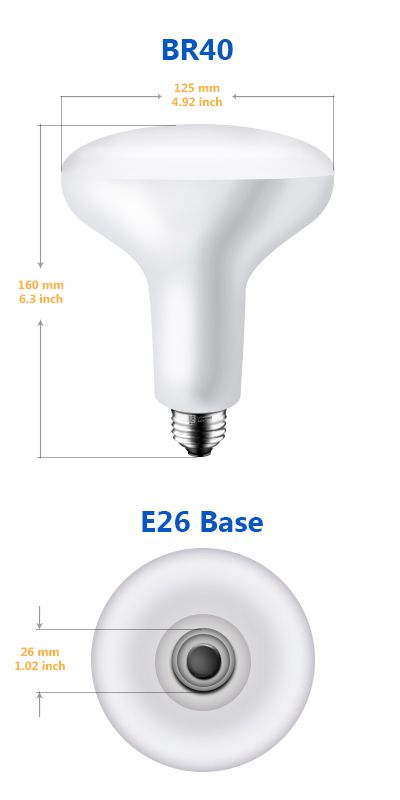
While floodlight bulbs typically use the same E26 base as a regular light bulb, the bulb head itself is much larger. They're usually BR30 or BR40 lights, meaning they're 3.75″ and 5″ wide respectively across the bulb head — the BR number indicates the diameter in eighths of an inch.
That makes a BR40 around two-and-a-half times the diameter of a typical spotlight bulb (GU10s measure around 2″ wide) and roughly twice the diameter of a common A19 light bulb (which are 2.4″ wide).
Difference #2: Shape (and Beam Angle)
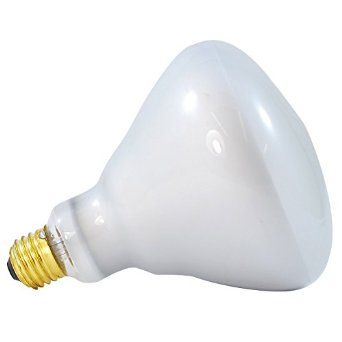
Most floodlight bulbs are BR-shaped, though you can also get PAR bulbs. PAR bulbs use a mirrored reflector behind the LED to concentrate and direct the beam, making them better for accent or task lighting than general flood use. BR bulbs throw a wider, softer beam — typically around 120° — while PAR floodlights are tighter at roughly 25°–40°.
By comparison, a GU10 spotlight beam runs around 35°–60°, while a standard A19 bulb spreads light at roughly 180° but at much lower intensity — producing a gentle, ambient glow rather than the focused brightness of a flood.
Difference #3: Wattage
Wattage varies a lot depending on whether you're looking at a residential flood bulb or a standalone outdoor fixture:
- Residential LED flood bulbs (BR30/BR40): 12–18W
- Outdoor/commercial floodlight fixtures: 30–80W for residential driveways and yards, and 100–500W+ for parking lots, warehouses, and stadium lighting
- GU10 spotlights: 1.8–11W (typically around 5W)
- A19 bulbs: 4–13W
Even at the high end, that's nowhere near the wattage drawn by older incandescent equivalents — a 60W incandescent A19 maps to roughly an 8–10W LED, and a 100W halogen flood maps to around a 15W LED bulb.
Difference #4: Luminosity
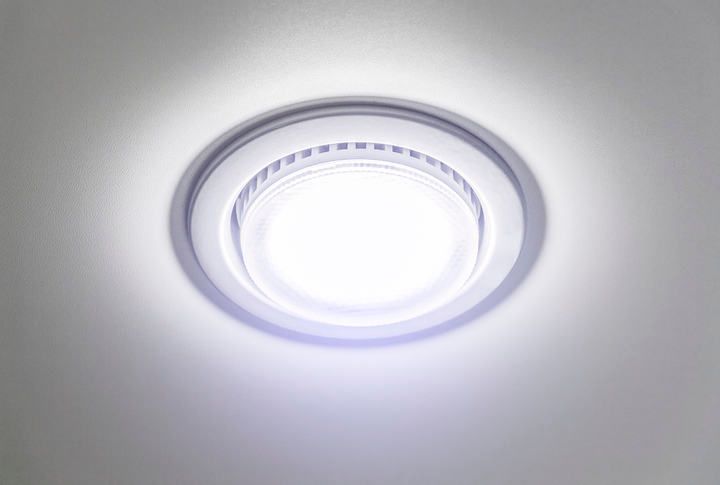
Floodlights are typically brighter than other bulbs because their maximum wattage is higher. A typical LED flood lamp puts out around 1500 lumens, with outdoor fixtures pushing into the thousands.
Regular lighting is lower – expect around 300 lumens for a spotlight (you typically use several in a room) and closer to 600 lumens for an average A19 bulb, though higher-wattage A19s can produce much more.
As a rough guide for matching lumens to space: 700–1300 lumens is plenty for a small porch, 1500–2000 lumens suits a patio or modest yard, and 2000–4000+ lumens is more appropriate for a driveway or large yard. Going much brighter than the space needs is a common mistake — a 4000-lumen flood on a small porch will feel harsh rather than welcoming.
Difference #5: Purpose
LED floodlights are designed for outdoor spaces or indoor settings where a lot of light is needed – often commercial. Their purpose is to produce a high amount of light across a wide beam angle to illuminate a large space.
Spotlight bulbs are directional, used as task lighting to illuminate the space directly below. A19 bulbs are more ambient – doing a similar job to a floodlight but for a smaller space, and with a gentler light.
Difference #6: Voltage
LED flood bulbs run on the regular circuit voltage of your home – 120V in the US, or 220–240V in Europe and the UK. So do most common household LED bulbs (A19, BR, PAR, and GU10) — the driver inside the bulb steps voltage down internally, but the socket itself sees mains voltage.
The exceptions are specialty low-voltage spotlights: GU5.3 (MR16), GU4 (MR11), and similar fittings run on 12V and need a transformer or LED driver between the mains supply and the bulb. A driver's job is to convert and regulate the power going to the LED chip — with mains-voltage bulbs that driver is built into the bulb itself, but with 12V bulbs it sits in the fixture or wiring. That matters at purchase time: a 12V bulb plugged into a mains socket will fail immediately, and a mains bulb wired through a 12V transformer won't light up at all.
Other Specs To Check Before Buying
Beyond the six headline differences, a few other specs are worth a look — especially when comparing specific bulbs side by side.
Color Temperature (CCT)
LED floodlights commonly come in 3000K (warm white), 4000K (neutral white), and 5000K (daylight). Warmer tones around 2700–3000K feel cozier and suit porches or accent areas; 4000K is a good general-purpose neutral; 5000K daylight is the brightest-feeling and best for security or task lighting where crisp visibility matters. The same lumen output will read very differently across these temperatures.
Lifespan
LED flood bulbs are typically rated for 15,000–25,000+ hours, with premium models pushing 50,000 hours. That works out to roughly 15–25 years of typical residential use — and it's a major advantage over halogen equivalents, which usually last 2,000–4,000 hours.
Dimmability
Many BR40 LED floodlights are dimmable, but check both the bulb's label and your dimmer switch. Older dimmers designed for incandescent or halogen loads can cause flickering or buzzing with LEDs — if you're installing a dimmable LED, plan on a compatible LED-rated dimmer for best results.
IP Rating (for Outdoor Use)
For any floodlight going outside, check its IP (Ingress Protection) rating. IP65 is the minimum for most outdoor installations and means the fixture is protected against dust and low-pressure water jets. IP66 handles stronger jets, and IP67 can survive temporary submersion — useful for ground-mounted or coastal applications. Indoor bulbs typically carry no IP rating and shouldn't be exposed to rain or moisture.
Can You Put An LED Floodlight Bulb In A Regular Socket?
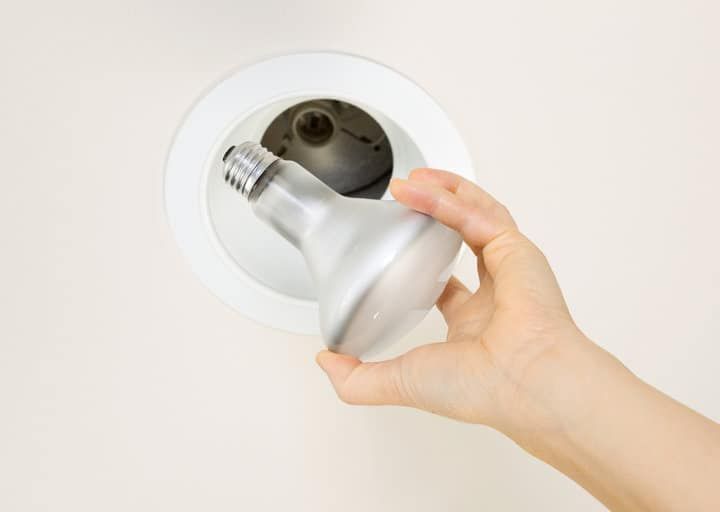
You can install an LED floodlight bulb in any socket and fixture where it physically fits. If the base type matches and there's enough room around the bulb head, it will work. Many LED floodlights use the same E26 base as a regular A19 light bulb, so the socket itself rarely needs replacing.
Floodlights tend to be used for larger spaces, both indoor and outdoor — common applications include security lighting for a garden, illuminating a warehouse, or lighting up a driveway. You might also choose one for an office space, a garage workshop, or an open-plan room — anywhere you want strong, wide light coverage.
Just remember that floodlights are very wide-angled and very bright. A 1500-lumen flood in a small porch or hallway will feel overwhelming compared to the same bulb on a driveway — so think about the scale of the space and consider lumen output and color temperature before committing.
FAQ
Can You Use Floodlights Inside?
Yes — provided the base fits your indoor fixture and there's adequate airflow around the bulb. LED floodlight bulbs already include a built-in heat sink, but if the fixture is fully enclosed, choose a bulb specifically rated for enclosed fixtures. Otherwise heat buildup can shorten its lifespan.
Can I Replace Halogen Flood Lights With LED?
Yes, but check the bulb's documentation first. If your halogen lights use a 12V transformer (common with MR16/GU5.3 fittings), many LED bulbs are designed to work with existing magnetic transformers, and some are compatible with electronic transformers too — but mismatches can cause flickering or non-operation. If your bulbs aren't transformer-compatible, replace the transformer with an LED driver rather than disconnect it.
Are All Floodlights The Same Size?
No — flood lights come in a range of sizes, so check the dimensions when buying to make sure the bulb fits your fixture. A bulb that's too big for a recess can trap heat and shorten its lifespan if there isn't space for air to flow around it.
What Beam Angle Should A Floodlight Have?
Most BR-style flood bulbs have a beam angle of around 120°, which is wide enough for general area lighting indoors or on a porch. PAR-style floods are tighter at 25°–40° and work better when you want to direct light at a specific feature like a sign or a façade. For wide outdoor coverage, 100°+ is generally what you want.