
Will LED Bulbs Work With DRL?
An LED bright enough to make your car visible by day can blind oncoming drivers by night — unless the circuit actively dims it. That one detail decides whether your DRL upgrade is legal or dangerous.
 Eugen
EugenEugen Nikolajev
Creator of LED Lighting Info
Hi, I am Eugen. I was always one of those kids who had all sorts of weird lighting gadgets for every occasion.
Now, I want to share my knowledge and experience about lighting with you on LED Lighting Info.
Read my editorial standards
Key Takeaways
Yes, you can use LED bulbs as DRLs, but you need to ensure they're car compatible, correctly installed, and dimmed at night to prevent blinding other drivers. You might also need extra components such as a resistor or CANBus adapter to avoid flickering.
Daytime Running Lights (DRLs) are designed to be used during the day (the name's a clue) to make your car more visible.
Brighter isn't always better — an LED powerful enough to improve daytime visibility can blind oncoming drivers at night if the circuit doesn't dim it automatically.
So with LED bulbs being so much brighter than their halogen counterparts, are they suitable for DRLs?
There's a lot to make sure you get right, so in this article I'm going to explain:
- What safety conditions LED DRLs must meet
- What you need to consider when installing LED bulbs as DRLs
- Potential causes for your lights flickering
- The components you'll need to install an LED bulb as a DRL
Are LED Daytime Running Lights Safe To Use?
There are two types of Daytime Running Lights, and it's worth clarifying those first.
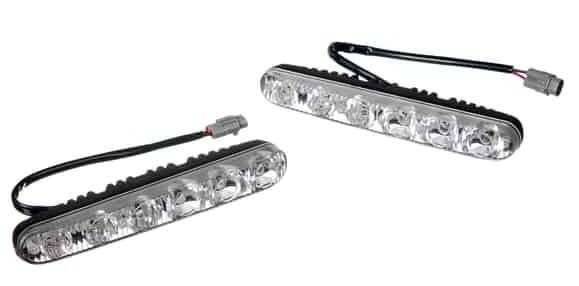
Many new cars, particularly those from European manufacturers, come with dedicated DRLs installed separately from the regular headlights. They automatically switch on when you turn on the ignition and switch off or dim when you turn the headlights on. They're normally only on the front of the vehicle, although some have them on the rear too.
European car manufacturers install these because, from 7 February 2011, all newly type-approved passenger cars and small delivery vans (categories M1 and N1) had to be fitted with DRLs under EU Directive 2008/89/EC. Trucks and buses followed in August 2012. Older cars don't need to be retrofitted, but anything new must have DRLs fitted.
Because of this, many cars will already come with LED DRLs installed, sometimes as a single light or as a strip. They're used because they're brighter during daylight hours and can easily be set up in a newer vehicle to switch off or dim at night when they could otherwise cause glare. Because DRLs run throughout the day, the low power draw of LED bulbs saves energy too.
Those laws don't apply everywhere. Canada has required DRLs on all new vehicles since December 1989 under CMVSS 108, but in the US they aren't mandatory.
Many vehicles that use DRLs just have them as a setting on the high beam bulb, so they're entirely optional. You can also retrofit headlamps to work on a DRL setting — they'll need to be programmed by a specialist with a dedicated circuit.
That setting is important. DRLs aren't supposed to illuminate the road; they're purely designed to make your car more visible to others. With the brightness of LED lights, you can't just add them as headlamps and leave them switched on, or you'll blind other drivers.
LED bulbs are directional, too — they aim light in a particular pattern. So buy a quality LED bulb from a reputable source to ensure it's been manufactured to the required standards. Otherwise, it might not be correctly aligned, which could cause it to dazzle other road users. The same applies to installation: a high-quality bulb installed incorrectly will have just the same issues.
Don't miss out: Can LED Bulbs Be Used In Projector Headlights?
There's no consumer-facing lumen rating in the regulations — DRL output is legally specified in candela (400–1,200 cd under UN ECE R87, or 500–3,000 cd under US FMVSS 108). In practice, a typical LED DRL strip draws 5–10 W and emits roughly 350–500 lumens. As a comparison, a typical halogen low-beam headlamp produces around 1,000–1,500 lumens.
LED bulbs are marketed as producing 200–300% more luminous output than a comparable halogen bulb and can certainly get much higher. However, they won't be road-legal as main headlamps. Those figures clearly demonstrate why DRLs need to be dimmed, particularly when using LED bulbs that can be many times brighter than the average DRL output, as otherwise you could dazzle oncoming drivers at night.
How Dimming Works In Practice
On factory-fit DRL circuits, dimming and switching are handled automatically by the vehicle's lighting control module — the DRLs come on with the ignition and dim or shut off when you turn on the low beams.
For an aftermarket retrofit, you'll typically need a DRL controller module to replicate that behaviour. The controller wires into the ignition and headlight feeds, ensuring the LED switches off (or drops to a dimmer setting) when the main beams come on. Without one, the bulb will run at full brightness whenever the car is on — which is both illegal and dangerous to oncoming drivers.
Read more: Why Do LED Bulbs Say For Off-Road Use Only?
Things To Consider When Installing LED As DRL
Before buying a bulb, run through this checklist:
- Match the wattage to the DRL circuit. Existing DRL circuits provide reduced power to keep the lights from shining too brightly. A bulb that draws too much will blow quickly; one that draws too little may flicker.
- Check vehicle compatibility. There isn't a one-size-fits-all bulb. Confirm the model fits your make, model, year, and headlamp housing type.
- Buy from a reputable brand. Bulb quality varies widely; cheap LEDs often have poor beam patterns, weak heat management, and short lifespans.
- Match the housing type. LEDs in enclosed automotive housings build up heat that degrades both output and lifespan. Choose a bulb explicitly rated for enclosed housings if your headlamp is sealed, and look for active cooling (fan or heatsink) appropriate to the wattage.
- Check MOT and road-legality requirements. In the UK and EU, retrofitting an LED bulb into a halogen housing typically isn't E-marked and can fail an MOT or roadworthiness inspection — even if the bulb itself is sold as road-legal. Confirm the specific bulb-and-housing combination is approved for road use in your jurisdiction before fitting.
Also read: When Should I Use Dipped Headlights?
Why Can LED DRL Flicker?
Sometimes, LED lights flicker when used as DRLs. It's a distraction for both you and other drivers, and you'll need to rectify it. The common causes:
- Poor bulb quality. Cheap LEDs often have unstable drivers and inconsistent output.
- Incorrect power match. The bulb may be drawing too little — or being damaged by too much — power for the circuit. Confirm compatibility with your vehicle.
- CAN bus fault detection. Many cars monitor each lighting circuit through the CAN bus. Because LEDs draw far less current than the halogen bulbs the system expects, it can interpret the bulb as failed — triggering a "bulb out" warning, hyperflashing, or cycling power to the circuit. A CAN bus adapter or load resistor restores the expected current draw and resolves the issue.
- PWM dimming. Some vehicles dim DRLs using pulse-width modulation — rapidly switching the circuit on and off. If the LED driver isn't designed to handle PWM signals, the bulb will flicker visibly. Look for a bulb explicitly rated as PWM-compatible.
There are other causes too, sometimes specific to the make and model of your car. This forum topic has some useful discussion if you're trying to diagnose a vehicle-specific issue.
I've also written another article on the causes of DRL flickering.
What Components Do You Need For Installing LED As DRL?
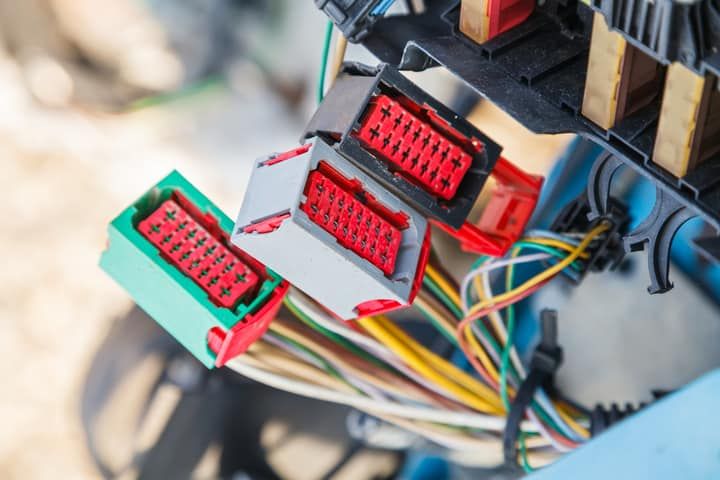
Beyond the bulb itself, the components you need depend on what your car already has and what symptoms you're trying to solve. Use this table as a starting point:
| Component | When You Need It | What It Does |
|---|---|---|
| CANBus Adapter | Car has a CANBus system; dashboard warning or flickering appears | Masks the LED's low current draw from the fault-detection circuit |
| Load Resistor | Flickering without a CANBus system, or as a cheaper alternative to an adapter | Adds resistance to mimic the current draw of a halogen bulb |
| DRL Controller | Retrofitting DRLs to a non-DRL headlamp circuit | Switches the DRL on with the ignition and dims/disables it at night |
Some CANBus adapters include built-in resistors. If your car doesn't have a CANBus system, a standalone resistor may be all you need to eliminate flickering. If you aren't sure which is right for your car, speak to your retailer — they'll be able to recommend the correct one.
Further reading: Do Off Market LED Headlights Void Car's Warranty?
Recommended Products
Disclosure: the links below are affiliate links — I may earn a commission if you buy through them, at no extra cost to you. I only recommend products I'd use myself.
I often recommend Lasfit — they sell great quality headlights and make it easy to browse their range, with sections for bulbs suited to different cars. They also sell these bulbs, which have a chip that lets you use your headlights as DRLs.
For a CANBus adapter, this one covers most common fitments and stops the error messages and flickering you can get with LED bulbs that draw lower power on a car with a CANBus system. Just check it's the right model for your vehicle before buying.
Final Words
Studies have shown that Daytime Running Lights can improve driving safety, although some North American studies refute the effectiveness when compared to low-light countries in Europe.
If you opt for DRLs, LED bulbs are a practical solution — they draw lower power and are bright enough during the day to ensure they're visible. They just need to be dimmed correctly at night, fitted with the right adapter or resistor for your car's electrical system, and chosen from a quality brand for the right housing type. Get those things right and you've got a safe, efficient, road-legal upgrade.