
When Should I Use Dipped Headlights?
Several U.S. states require your headlights on whenever your wipers are running — and high beams must be dimmed for the car ahead of you, not just the one coming toward you.
 Eugen
EugenEugen Nikolajev
Creator of LED Lighting Info
Hi, I am Eugen. I was always one of those kids who had all sorts of weird lighting gadgets for every occasion.
Now, I want to share my knowledge and experience about lighting with you on LED Lighting Info.
Read my editorial standards
Key Takeaways
While the law varies depending on your location, dipped headlights should generally be used from sunset until sunrise, when it’s raining, or when any other condition restricts your vision to less than 500 feet.
Most drivers know to flip the headlights on after dark. Fewer realize that a handful of U.S. states require them any time the windshield wipers are running, or that high beams must legally be dimmed not just for oncoming cars, but for the car ahead of you too.
It’s not just a case of switching on the lights when it’s dark. The law covers visibility, weather, and even what other drivers around you are doing — and the rules differ from one state to the next.
In this article, I’ll cover:
- What dipped headlights actually are
- When to use dipped headlights, with a state-by-state breakdown
- When to switch to full beam — and when you legally can’t
- How front and rear fog lights differ
- Whether dipped lights can replace DRL
What Does Dipped Headlight Mean?
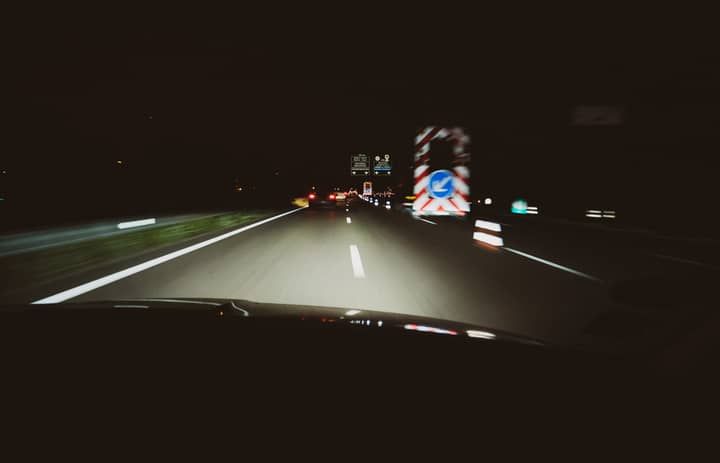
Dipped headlights are just the proper term for your standard headlights — the ones you’ll use most of the time on your car.
In some parts of the world they’re called low beam headlights.
The name comes from the angle of the bulb. They might look like they’re pointing straight ahead, but the light is actually directed down towards the road. That downward angle is what stops them from blinding or dazzling oncoming drivers.
Dipped headlights are also angled slightly to one side, depending on where the car was sold. In countries that drive on the right, the beam is biased rightwards — again to avoid shining into the eyes of any oncoming driver on your left.
Many modern European cars let you adjust the beam pattern when you cross between the Continent and the UK — either through a “travel mode” menu setting on adaptive LED systems, or with manual beam deflectors (small stickers or blanking tabs) on older cars. The steering wheel doesn’t move, but the headlight cut-off does.
Some cars use a single dual-filament bulb (such as an H4) for both modes: the low-beam filament has a small shield beneath it that creates the sharp cut-off pattern for dipped beam, while the high-beam filament fires without a shield to throw light further down the road. Many modern cars instead use entirely separate projector housings for each mode, especially on LED and HID systems.
Today, three bulb technologies dominate: halogen, HID (xenon), and LED — the last of which is now standard on most new vehicles. Whatever your setup, always make sure replacement bulbs are suitable for your make and model.
When Should You Turn Dipped Headlights On?
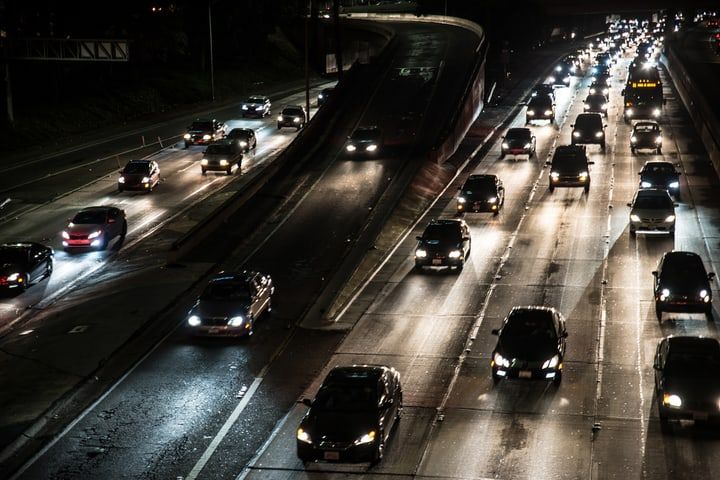
Three triggers cover most situations: darkness, rain, and reduced visibility. The exact wording differs from one state to the next.
Various US states differ on how they define night. Some, like New York and Georgia, require headlights from 30 minutes after sunset until 30 minutes before sunrise. Others, like Florida and Kansas, simply say sunset to sunrise. Illinois uses “dusk until dawn.” And the visibility thresholds vary too — Alabama and Hawaii set the bar at 500 feet, while Nevada and Oklahoma raise it to 1,000 feet.
| State | Headlights-On Rule | Visibility Threshold |
|---|---|---|
| New York | 30 min after sunset – 30 min before sunrise | — |
| Georgia | 30 min after sunset – 30 min before sunrise | — |
| Florida | Sunset to sunrise | — |
| Kansas | Sunset to sunrise | — |
| Illinois | Dusk until dawn | — |
| Alabama | — | Below 500 ft |
| Hawaii | — | Below 500 ft |
| Nevada | — | Below 1,000 ft |
| Oklahoma | — | Below 1,000 ft |
Beyond darkness, rainfall is the second trigger. Some states don’t mention rain specifically, others list rain, snow, and ice. Many simplify it: if your windshield wipers are on, your headlights must be on too.
Finally, when visibility drops for any reason — fog, dust, heavy spray — headlights are mandatory once you can’t see clearly to the state-defined distance. The basic rule: if anything stops you from seeing the road ahead, switch the headlights on.
A note on automatic headlights: most newer cars have an “auto” position that uses an ambient light sensor. It works well at dusk, but don’t rely on it in every condition — many auto systems won’t trigger in heavy rain or fog where the ambient light alone is fine. If your state ties headlights to windshield wipers, you’ll need to flip the switch manually.
When Should You Switch From Dipped To Full Beam Light?
If visibility is what matters, why not just use full beam all the time?
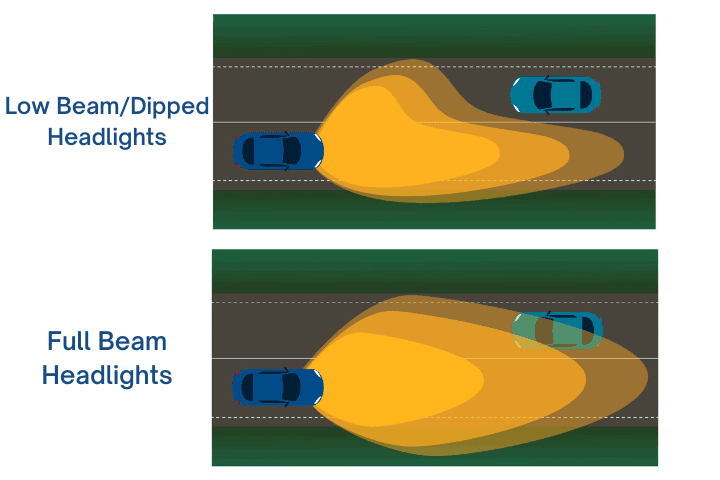
Because full beam isn’t aimed to spare other road users. It projects straight ahead, well above the dipped cut-off, and will blind anyone caught in it. Full beam is designed for stretches of unlit road — country lanes, rural highways — where dipped headlights don’t reach far enough. The laws on when you must dim are more consistent across U.S. states than the dipped-light rules above.
Dim from full beam to dipped when:
- An oncoming vehicle is within 500 feet.
- You’re within 200–300 feet behind another vehicle on your side of the road (the exact distance varies by state — California and Florida use 300 feet; New York and Colorado use 200). Full beam reflects off their rearview mirror and dazzles them just as effectively as it would head-on.
- You’re driving in fog, heavy rain, or snow. Some states, such as Texas, explicitly ban full beam in adverse weather, because the moisture in the air reflects the extra light straight back at you and at other road users.
- You’re in a built-up area where street lighting is already adequate.
Using Fog Lights Correctly
Front and rear fog lights do different jobs, and the two are commonly confused.
Front fog lights cast a low, wide, flat beam aimed at the road surface directly in front of the car — below the fog layer. The point is to help you see by lighting what’s near the wheels without bouncing light back off the suspended moisture and washing out the scene.
Rear fog lights are red and much brighter than ordinary tail lights. They exist to make your car visible to drivers behind you in heavy fog, snow, or road spray. Switch them off in clear conditions — they dazzle following drivers at close range, and in many jurisdictions using them outside of poor visibility will earn you a ticket.
If you find yourself in fog and need extra visibility, use the fog lights on your car if it has them — and turn them off the moment visibility improves.
Can You Use Dipped Lights As DRL?
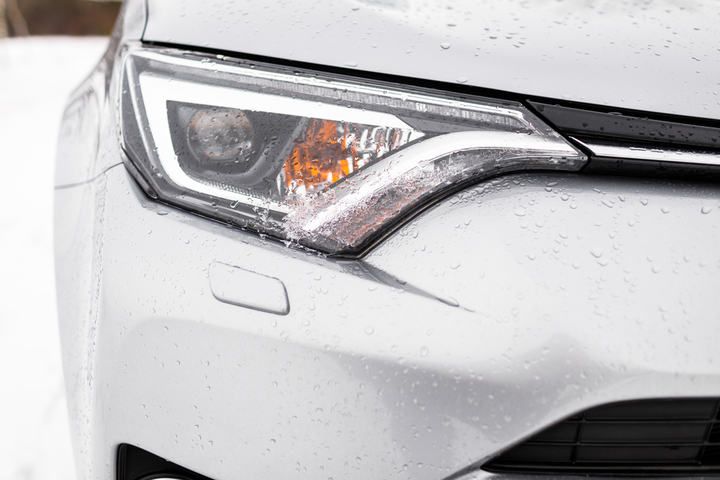
Daytime Running Lights (DRL) are designed to make your car more visible during daylight, so they need to register against ambient sunlight.
DRL output varies widely by manufacturer. The regulation that approves them (UNECE R87) specifies on-axis luminous intensity between 400 and 1,200 candela rather than lumens, but typical LED DRL modules fall roughly in the 400–900 lumen range, with some performance modules going higher.
For comparison, dipped halogen low-beams typically produce around 1,000–1,650 lumens depending on bulb type (H7, H11, etc.), HID/xenon low-beams generally produce 2,800–3,500 lumens, and modern LED low-beams sit somewhere in between. Dipped headlights are angled downwards, though, so much of that output goes into the road rather than forward at eye level.
So yes — you can use dipped headlights as DRL, but they won’t be as effective as dedicated DRL units, and they’ll draw more power.
Since 7 February 2011, the EU has required all new type-approved passenger cars and small vans to be fitted with daytime running lights (Directive 2008/89/EC), with trucks and buses following from August 2012. That’s exactly the point of the regulation: a low-power, daytime-only set of lights that keeps vehicles visible without the energy cost or oncoming dazzle of full headlights.
One thing to be absolutely clear on — you might be able to use dipped headlights as DRL, but the reverse doesn’t apply. DRL isn’t a sufficient replacement for dipped headlights at night.
Why? Because DRL isn’t connected to your tail lights. If your dipped lamps aren’t switched on, the back of your vehicle isn’t illuminated at all — which is both illegal and extremely dangerous, especially at night. So don’t assume that DRL replaces headlights completely.
Final Words
Knowing when to use dipped beam and when full beam is appropriate isn’t just a courtesy to other drivers — in most states it’s a legal requirement, and in fog or heavy rain it’s the difference between seeing the road and washing it out.
Driving at night or in poor weather is always more dangerous. Using your car lights properly — particularly on roads without street lighting — is one of the simplest things you can do to stay safe.