What Is The Difference Between Floodlight, Spotlight And Downlight?
Eight downlights, one flat shadowless kitchen — the chopping board unlit, the hob no better. More of the same fixture never fixes a lighting problem; the right type does.
 Eugen
EugenEugen Nikolajev
Creator of LED Lighting Info
Hi, I am Eugen. I was always one of those kids who had all sorts of weird lighting gadgets for every occasion.
Now, I want to share my knowledge and experience about lighting with you on LED Lighting Info.
Read my editorial standards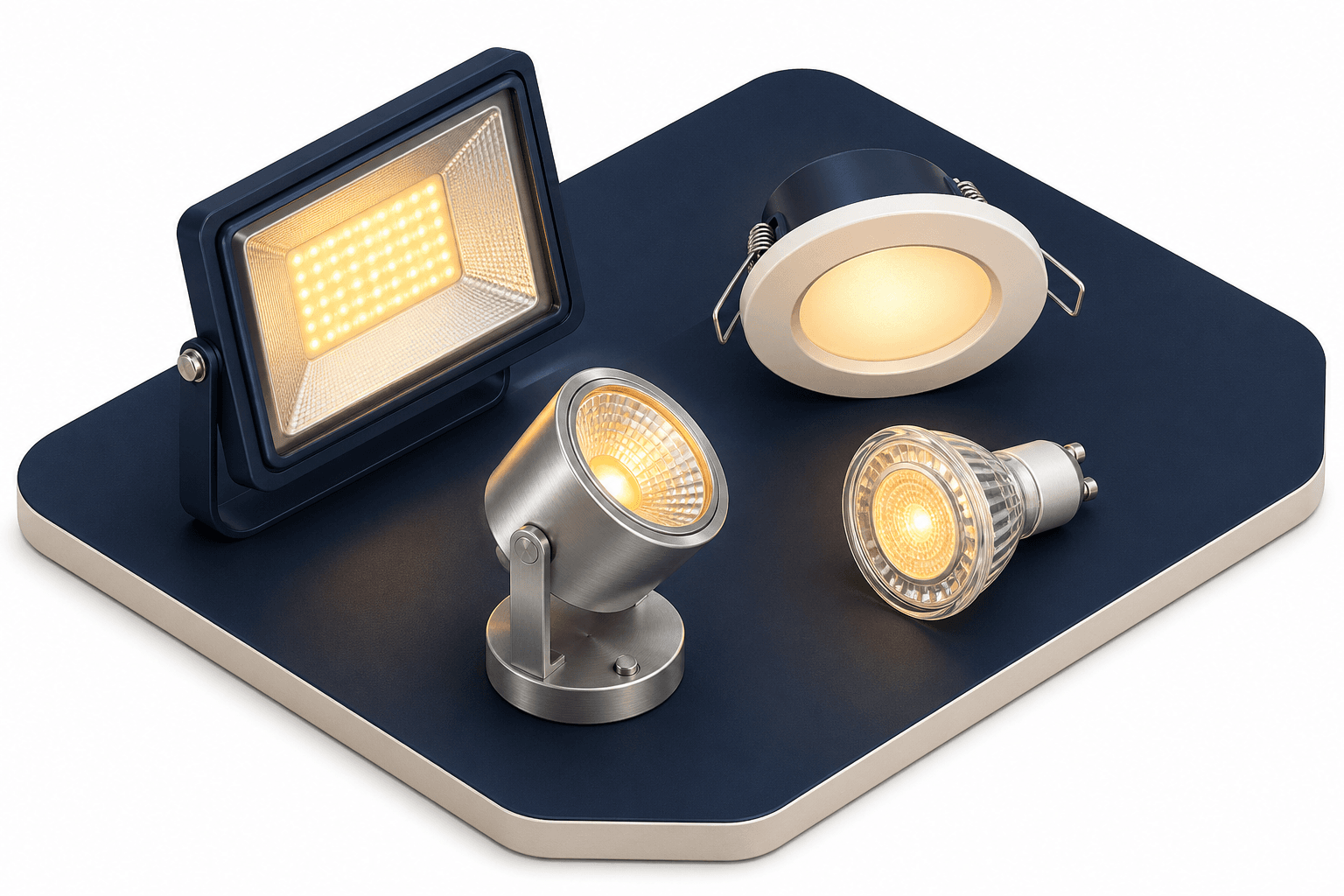
Key Takeaways
Spotlights throw a narrow beam at a single point. Floodlights wash a wide area with light. Downlights sit recessed in the ceiling and direct light downward. Pick the wrong one — or only one — and a kitchen feels glary, a garden looks staged, or a security light blinds the neighbours. This guide explains what each type actually is, where it works best, and how to choose between them
The first time I tried to light a kitchen myself, I bought eight downlights and hoped for the best. The result was a flat, evenly-lit room with shadows falling exactly where I needed to see, across the chopping board, and on the hob.
Spotlights, floodlights, and downlights each do a different job, and a room needs the right combination rather than more of any one type.
Spotlights Explained
Spotlights are a concentrated light source. They produce narrow cones of light that can be aimed and adjusted in different directions.
Spotlight beams are typically narrow — usually between 10 and 30 degrees, though some manufacturers extend the definition up to 45 degrees. The narrower the beam, the more concentrated the light, which is why spotlights are the default for stage lighting, retail accenting, and highlighting artwork or architecture.
Spotlights mount on a plate or fixing bracket attached to a wall or ceiling, often carrying single, double, triple, or quadruple moveable heads.
The most common LED spotlight bulbs are GU10s and MR16s. GU10s are mains-voltage lamps (around 240V in the UK/EU and 120V in North America), so they plug straight into existing fittings — but UK and US GU10 bulbs aren't interchangeable. MR16s are 12V lamps everywhere and need an external transformer or LED driver to step the mains voltage down.
Floodlights Explained
Floodlights are the polar opposite of spotlights. As the name suggests, they produce a very wide beam of light, which makes them ideal for illuminating larger areas.
The beam spread of a floodlight typically falls between 60 and 120 degrees, with 90° being a common middle-ground choice for residential and commercial fixtures. That wide spread is why floodlights are the default for car parks, sports pitches, security lighting, and façade illumination.
The world's first floodlit football match took place at Bramall Lane in Sheffield on 14 October 1878, using portable steam-powered arc lights in front of a crowd of around 20,000 (Spartacus Educational). Reliable, regular use of floodlights in English football didn't take hold until the 1950s.
An LED floodlight has more parts than you might expect. The core components are:
- Housing — usually die-cast aluminium, doubling as a heat sink that keeps the LEDs cool.
- LED module — the actual diodes mounted on a metal-core PCB.
- LED driver — converts AC mains into the DC current the LEDs need; this part determines lifespan, dimming compatibility, and flicker performance.
- Optical system — a lens, reflector, or both, sealed behind tempered glass to control beam shape and protect the LEDs.
- Yoke or mounting bracket — lets the fixture be aimed and locked in place.
Downlights Explained
Where spotlights protrude from the surface they're attached to, downlights are a covert luminaire — embedded inside the ceiling or wall so that only the front face is visible. That's why they're the default in modern homes that want a clean, streamlined look.
Downlights are also a diverse category. They can be recessed or flush to the surface, fixed or rotating, and offer narrow, medium, or wide beam widths.
LED downlights fall into four main categories:
- Fixed — light is emitted straight down and cannot be adjusted. Best for general ambient lighting where coverage is even.
- Tilt — the lamp inside the fixture can typically be angled 20–35 degrees from vertical (with 30° being a common spec), letting you direct the beam without breaking the flush ceiling line. Useful for highlighting a feature wall or worktop.
- Eyeball — similar to tilt downlights but with a half-sphere head that protrudes slightly, allowing wider rotation. Choose these when you need more aiming flexibility than a tilt provides.
- Wall washers — a hinged housing designed to spread an even sheet of light down a wall or across artwork. Great for galleries, hallways, and feature walls.
Most downlights consist of a steel or aluminium casing hidden from view and a decorative fascia. During installation, a hole is cut into the wall or ceiling and the fixture is held in place with springs or compression clips.
Spotlight vs Floodlight vs Downlight: Side-by-Side
The main difference between the three comes down to beam angle — measured between the two points on either side of the centre where luminous intensity (in candela) drops to 50% of the peak. A narrower beam concentrates the same amount of light into a tighter area; a wider beam spreads it across a larger one.
| Feature | Spotlight | Floodlight | Downlight |
|---|---|---|---|
| Beam angle | 10–30° (up to 45°) | 60–120° | Varies (commonly 30–90°) |
| Typical mounting | Wall or ceiling bracket | Exterior wall, pole, or yoke | Recessed in ceiling |
| Best use | Accent and task lighting | Area, security, sports | General room and zone lighting |
| Directionality | Adjustable | Fixed or aimable | Fixed, tilt, or eyeball |
| Where you'll see them | Galleries, retail, stages | Driveways, car parks, pitches | Kitchens, hallways, offices |
Where Each Light Works Best
Different beam angles suit different jobs. Match the fixture to the room — and to what you want the light to do.
Spotlights cast a localised beam, which makes them great for accentuating specific points around the home or garden. They show up frequently in museums, above garage doors, and in restaurants. At home, use them to pick out artwork, joinery, or interesting architectural detail — anything you want the eye to land on first.
Floodlights tend to be used where coverage matters more than precision: car parks, warehouses, driveways, and sports pitches. Their broad beam makes them too harsh for most indoor rooms — the space ends up feeling washed-out and clinical.
Downlights are the workhorse of modern interiors. Use them to create zones, light a corridor, or wash an entire ceiling with even, ambient light. Because they sit inside the surface, plan the install carefully — you need clear space above the ceiling for the fixture body and any driver.
Buying Considerations: Brightness, Colour, and Outdoor Ratings
Beam angle gets most of the attention, but three other specs matter just as much when you're actually choosing a fixture.
Lumens, not watts
Lumens measure how much light a fixture produces; watts measure how much electricity it draws. With LEDs, focus on lumens. As a rough guide:
- Downlights: 400–800 lumens each is typical for general ceiling installs.
- Spotlights: 300–700 lumens is common for accent use; higher for task lighting.
- Floodlights: 1,000–5,000 lumens for residential security and façade lighting; commercial models can run far higher.
Colour temperature (CCT)
Colour temperature is measured in kelvin (K) and shapes how a space feels. Warm white (2700–3000K) is cosy and sits well in living rooms and bedrooms. Neutral white (3500–4000K) is a good compromise for kitchens, bathrooms, and home offices. Cool white (5000K+) reads as crisp and bright — useful for security floodlights and garages, but harsh in living areas.
IP rating for anything outdoors
Any spotlight or floodlight installed outside needs an Ingress Protection (IP) rating. IP44 is the minimum for sheltered locations (splash-proof); IP65 or above is the right choice for fully exposed installs (dust-tight and resistant to water jets). An indoor-rated fixture will fail quickly outdoors and can become a shock hazard.
Which Lights Are Best for the Kitchen?
Good kitchen lighting layers ambient, task, and accent light so the room feels welcoming when you walk in and stays bright enough to chop onions safely.
Most kitchens use tilt or eyeball downlights as the primary ambient layer. They blend into the ceiling, can be aimed at worktops, and pair well with a dimmer for evening use. Aim for around 300–500 lux on worktops; that usually means a downlight every 1.0–1.2 metres, with extras over the sink and hob.
Spotlights or pendant clusters work well over islands and dining tables, where you want a defined, slightly more decorative pool of light. Add under-cabinet LED strips to stop your own shadow falling on the worktop while you're prepping food — this is the single most useful upgrade in most kitchens.
Stick to a consistent colour temperature across all the fixtures — mixing warm and cool whites in the same room looks chaotic. Neutral white (around 3500–4000K) is the standard kitchen choice. Confirm fixtures are dimmable and that the dimmer is rated for LED loads before you buy.
Floodlight or Spotlight: What Should You Use Outdoors?
When choosing landscape lighting, start with the purpose. Are you trying to flood an area with light for visibility and security, or pick out a single feature?
If you want broad coverage across a driveway, garden, or façade, floodlights are the answer. Their wide beam is ideal for large areas, and exterior lighting is also a well-known crime deterrent. The downside: you have little control over where the beam falls. In a small yard or close to neighbours, floodlights spill light into places you don't want it.
For highlighting a particular feature — a doorway, footpath, statue, or specimen tree — reach for spotlights instead. Their narrow, concentrated beam lets you direct light precisely where you want it, without causing glare or unnecessary light pollution.
Whichever you choose, check the IP rating before installing. Outdoor fixtures live in the weather; indoor-rated ones won't survive a winter.
Final Words
Between spotlights, floodlights, and downlights, almost any lighting requirement around the home or property is covered. Spotlights pin down focal points, floodlights spread light across large areas, and downlights provide clean, recessed ambient light.
My rule of thumb: pick the type by the job (accent, area, ambient), then check beam angle, lumens, colour temperature, and IP rating in that order. Get those four right and the rest tends to fall into place.
FAQ
What's the difference between a spotlight and a floodlight?
Beam angle. Spotlights have a narrow beam of roughly 10–30 degrees that concentrates light on a single point. Floodlights have a wide beam of 60–120 degrees that spreads light over a large area. Choose spotlights for accent or task lighting, and floodlights when you need broad coverage.
Can I use floodlights or spotlights indoors?
Spotlights are well suited to indoor use — accent lighting on artwork, joinery, and architectural features. Floodlights are usually too harsh for indoor rooms and tend to make a space feel washed-out and clinical, so they're best kept for garages, exterior walls, and outbuildings.
What IP rating do I need for outdoor lights?
IP44 is the minimum for sheltered outdoor installs (splash-proof). For fully exposed locations — driveways, façades, garden lighting — choose IP65 or above, which is dust-tight and resistant to water jets.
Are GU10 and MR16 bulbs interchangeable?
No. GU10 is a mains-voltage lamp (around 240V in the UK/EU and 120V in North America), while MR16 is a 12V lamp that needs a transformer or LED driver. The pin patterns also differ. Check the existing fitting before buying replacements.
What colour temperature is best for downlights?
Warm white (2700–3000K) suits living rooms and bedrooms; neutral white (3500–4000K) works best in kitchens, bathrooms, and offices; cool white (5000K+) is best reserved for garages, workshops, and security lighting. Keep the colour temperature consistent across fixtures in the same room.