
How To Choose LED Replacement For Compact Fluorescent Lamp (CFL)
That code on your CFL — CFQ26W/G24q-3/830 — isn't random; it encodes tube shape, pin type, and color temperature. Read it once, and finding the right LED replacement becomes straightforward.
 Eugen
EugenEugen Nikolajev
Creator of LED Lighting Info
Hi, I am Eugen. I was always one of those kids who had all sorts of weird lighting gadgets for every occasion.
Now, I want to share my knowledge and experience about lighting with you on LED Lighting Info.
Read my editorial standards
Key Takeaways
You can choose LED replacements for existing CFL bulbs and fixtures by identifying the correct pin-type and buying plug-and-play options with the same pin-type. LED bulbs consume less electricity and provide better quality light.
If you still have CFL fixtures at home, you're not alone — but LED replacements have become so affordable and capable that the switch now makes clear financial and practical sense.
Filament bulbs came first. Compact fluorescent lamps (CFLs) followed as a more efficient replacement. Today, LEDs have surpassed both — and federal efficiency rules have effectively phased CFLs out of major US retailers.
Why Is LED a Better Alternative to CFL?
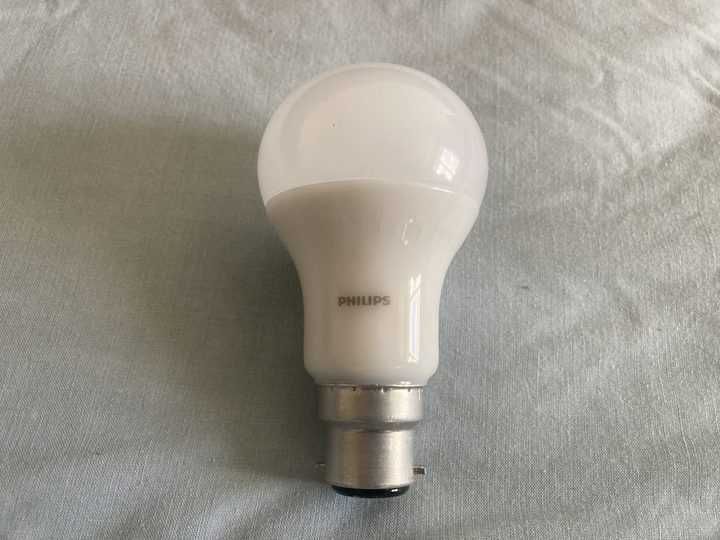
There is a fundamental difference in how each technology produces light.
A CFL is a phosphor-coated tube filled with mercury vapor. A ballast applies a high-voltage surge that ionizes the vapor, creating UV radiation that excites the phosphor coating to produce visible light. The tube is usually twisted into a spiral that resembles a filament bulb.
By contrast, LEDs are semiconductor diodes that emit light directly when current passes through them — no gas, no mercury, no phosphor needed for the basic light generation.
Here's how the two technologies compare on the features that matter most when choosing a replacement.
| Feature | CFL | LED |
|---|---|---|
| Lifespan | 6,000–15,000 hours (ENERGY STAR min 10,000) | 15,000–25,000 hours (premium up to 50,000) |
| Efficacy | 50–70 lumens per watt | 80–130 lm/W (premium models 180+ lm/W) |
| CRI (color accuracy) | ~80 typical; budget 70–80; premium 85–90+ | 80–95+ widely available |
| Light direction | Omnidirectional; loses intensity in focused fixtures | Directional; minimal loss in focused fixtures |
| Mercury content | Yes — requires special disposal | None |
| UV emission | Small amount; can fade fabrics over long exposure | Negligible |
| Dimming | Limited and often poor | Wide selection of dimmable options |
A Closer Look at CRI
CRI (color rendering index) measures how accurately a light source displays color. Aim for at least 80 — the closer to 100, the more flattering and natural colors look.
Most consumer CFLs sit around 80 CRI. Budget models drop to 70–80, while tri-phosphor and specialty CFLs reach 85–90+. Modern LEDs commonly hit 80–95+, and high-CRI options are easier to find than they used to be — making LEDs the safer pick when color quality matters.
Imagine getting ready in a bathroom or vanity with low-CRI bulbs — makeup and clothing colors end up looking dull and washed out.
Converting From CFL To LED: Main Watchouts
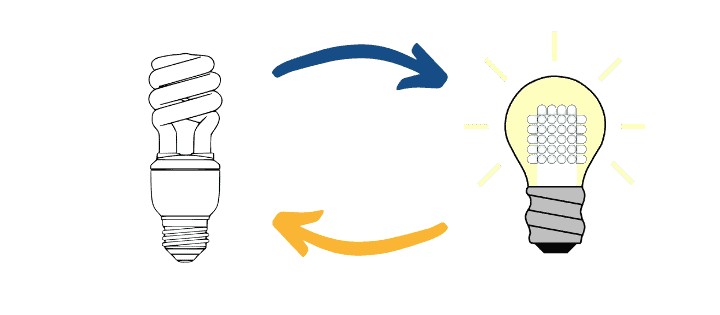
There are a few things to verify before ordering a batch of LEDs to replace your CFLs.
If possible, bring your old CFL bulb when shopping — matching the base type visually is faster than decoding the label.
CFL bulbs are trickier to replace than screw-base bulbs because you need the correct base/pin configuration for plug-and-play options. Many manufacturers sell plug-and-play LED replacements that fit existing CFL fixtures without changing the ballast. Alternatively, you can use a converter plug (Amazon) to convert a pin base into the standard screw base.
Voltage
Always check the voltage marked on the bulbs — the CFL and the LED replacement should match. Some manufacturers offer LED plug-in replacements with universal voltage (120V–277V) for flexibility across fixtures.
Wattage and the Ballast
CFL fixtures only accept a specific wattage range, set by the ballast. The replacement bulb must match that rating.
Screw-base CFLs are self-ballasted — the ballast is built into the plastic base between the screw and the spiral tube, not in the tube itself. Pin-base CFLs (the focus of this article) have no internal ballast at all; the ballast lives in the fixture, which is why bypassing it is sometimes necessary when retrofitting to LED. The ballast provides the high-voltage surge that ionizes the mercury vapor, then regulates current to maintain steady operation.
Check the ballast specification for the wattage required by the bulb.
UV and Decor
CFLs emit a small amount of UV light, which over long exposure can fade fabrics and artwork hung near the fixture. (CFLs emit far less infrared heat than incandescent bulbs, so the concern is UV-related, not IR.) Switching to LED removes the UV exposure entirely.
Color Temperature (Kelvin)
One of the most common mistakes is grabbing whatever LED is on sale without checking the color temperature. Kelvin (K) describes how warm or cool the light appears:
- 2700K — warm white, similar to incandescent. Best for bedrooms, living rooms, dining areas.
- 3000K — soft white. A slightly cleaner warm light, popular in kitchens.
- 4000K — neutral white. Good for bathrooms, garages, workspaces.
- 5000K–6500K — daylight / cool white. Bright and bluish — fine for task lighting but harsh in living spaces.
Pick a Kelvin value that matches the room's purpose, not just the cheapest bulb on the shelf.
Dimmability
Many CFLs dim poorly or not at all. LEDs handle dimming far better, but not every LED replacement is dimmable — and not every dimmable LED is compatible with every dimmer. Look for "dimmable" on the packaging, and if your fixture uses a dimmer, check the manufacturer's compatibility list before buying in bulk.
Mounting Orientation
Note the orientation of the original bulb in the fixture (called the mounting): it can be vertical or horizontal. Some LED replacements are rated for only one orientation, so confirm before ordering.
Disposing of Old CFLs
CFLs contain mercury vapor, so most US jurisdictions prohibit throwing them in household trash. Major retailers like Home Depot, Lowe's, and IKEA accept used CFLs for free recycling — check earth911.com for a drop-off near you. If a CFL breaks, ventilate the room, avoid vacuuming the debris, and follow the EPA's cleanup steps.
Initial Cost: LED vs CFL
LED prices have fallen dramatically. Basic A19 LED bulbs are widely available for $1–$5 each in multipacks at major retailers, often less than CFLs cost when both were on shelves. Following federal efficiency rules, CFLs have largely been phased out at major US retailers.
Lifespan tilts the math even further. With a typical residential LED rated at ~25,000 hours and a CFL at ~10,000 hours, you'd need roughly 2–3 CFL bulbs to match one LED's life — and high-end LEDs at 50,000 hours could outlast 5 CFLs. The long-term savings comfortably justify the up-front cost — especially since CFLs are increasingly hard to source.
CFL to LED Fixture Compatibility
CFL base types take a little reading to decode, but they follow a consistent system once you know what to look for.
Plug-in CFL bulbs use a pin-type socket, unlike the screw-and-thread socket used in standard LED or filament bulbs. Depending on the shape of the CFL tube, there can be 2-pin or 4-pin bulbs, with sockets to match. Screw-type CFLs (self-ballasted) are also common — those behave like any standard bulb.
Pin-type CFLs use an identifying code that describes:
- Tube shape (T = tubular, Q = quad, TR = triple)
- Wattage (e.g., 13W, 26W, 32W)
- Base configuration (G or GX, with d = 2 pins, q = 4 pins)
A typical full code looks like CFQ26W/G24q-3/830 — CF = compact fluorescent, Q = quad tube, 26W = wattage, G24q-3 = base, 830 = 80 CRI / 3000K color.
T4 indicates the tube shape and diameter: "T" stands for tubular, and the number gives the diameter in eighths of an inch. So T4 means a tubular bulb 4/8 inch (0.5 inch / 12.7 mm) in diameter.
The base code can be broken down like this:
G24q - 1
│  │   └─ Wattage keying (1 = lowest in series)
│  └────── q = 4-pin configuration
└───────── Base diameter code (24 = 24 mm)
The suffix (-1, -2, -3) corresponds to different keying notches that match specific wattage ranges — typically G24q-1 ≈ 13W, G24q-2 ≈ 18W, G24q-3 ≈ 26W. The notch positions physically prevent installing a bulb of one suffix in a fixture keyed for another, even though the pin pattern looks identical.
Note also that GX24q is the higher-wattage 4-pin family while G24q is the lower-wattage family — match the exact designation, not just the pin count.
The light output (brightness), measured in lumens, is listed separately on the specifications, or you can use the table below for a quick reference.
How Much Power Does LED Use Compared to Fluorescent Light?
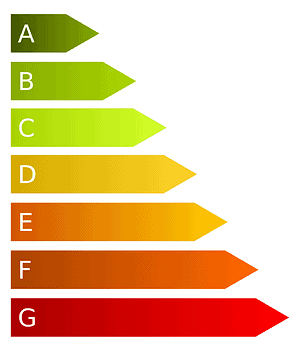
For a given lumen output, CFL and LED bulbs draw different amounts of power. Both use significantly less than incandescent.
Typical residential LEDs deliver 80–130 lumens per watt, with high-efficiency models like Philips Ultra Efficient achieving 180+ lm/W. The DOE's 2028 minimum efficiency standard for general service lamps is set at 120 lm/W. Typical CFLs deliver 50–70 lumens per watt — competitive a decade ago, but no longer.
In 2014, Cree achieved 303 lumens per watt for a white LED in a lab demonstration. Since then, multiple manufacturers have continued to push lab efficacy higher, and commercial high-power LEDs now ship with efficacies exceeding 220 lm/W.
Wattage Equivalent
Use this table to convert between incandescent, CFL, and LED wattage for the same lumen output. Incandescent equivalents are included because many people still think in those terms.
| Luminous Flux (LM) | Incandescent | CFL | LED |
|---|---|---|---|
| 400 Lumens | 40 W | 9 W | 7 W |
| 800 Lumens | 60 W | 13 W | 9 W |
| 1,600 Lumens | 100 W | 23 W | 19 W |
LED Replacement Options For CFL Fixtures
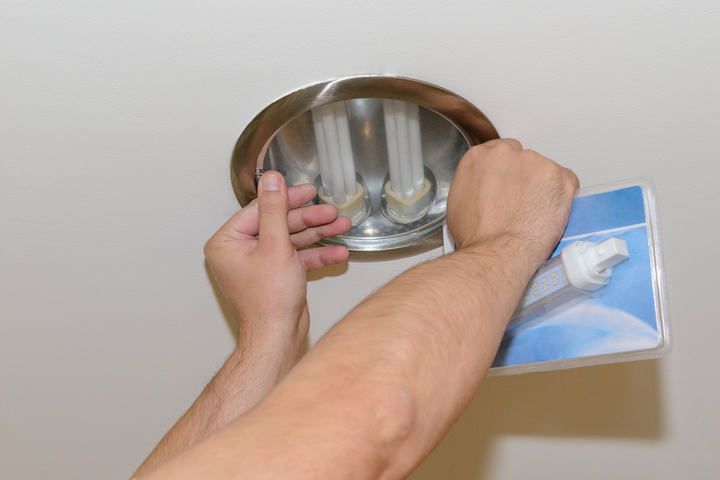
There are three main paths to retrofit a CFL fixture, ordered from easiest to most involved.
Option 1: Plug-and-Play Ballast-Compatible LED Bulbs
Some LED replacement plug-ins (Amazon) are designed to work with the existing CFL ballast. Match the pin-type, plug them into your existing socket, and you're done — no rewiring, no tools.
Option 2: Bypass the Ballast
Other LED replacements require rewiring the fixture to bypass or remove the existing ballast. The pin-type socket stays, but the ballast is taken out of the circuit. Bypass LEDs tend to be more efficient and reliable long-term, since they don't depend on an aging ballast — but the rewire requires basic electrical work, and the power must be off at the breaker.
Once the ballast is bypassed, you can also fit a pin-to-screw converter (Amazon), which opens up the entire universe of standard screw-base LED bulbs.
Option 3: Replace the Fixture
If you'd rather avoid pin-type sockets entirely, replace the fixture with one designed for a standard screw base or integrated LED. This is especially easy with can or recessed lighting (Amazon), where modern LED retrofit kits drop straight in.
What If the Ballast Is Inside the Fixture?
Some CFL fixtures — particularly recessed downlights and certain enclosed ceiling fixtures — have an integrated ballast that isn't user-accessible. In that case, the two practical options are: (1) install a ballast-compatible plug-and-play LED that works with the existing ballast as-is, or (2) replace the entire fixture with an LED retrofit kit. Trying to access an integrated ballast usually isn't worth the trouble.
Final Words
Switching from CFL to LED comes down to three checks: identify your base/pin type, choose your retrofit path (plug-and-play, ballast bypass, or full fixture replacement), and verify the voltage and wattage match. Bring an old bulb to the store if in doubt, and pay attention to color temperature and dimmer compatibility — those are the details people most often get wrong on the first pass.
With CFLs steadily disappearing from store shelves and LED prices at historic lows, there's no real reason left to wait.