
Can Dimmer Switch Be Used On A Ceiling Fan?
A phase-cut dimmer quietly cooking a ceiling fan motor is a documented fire hazard — and the wiring failure that causes it has nothing to do with too much voltage.
 Eugen
EugenEugen Nikolajev
Creator of LED Lighting Info
Hi, I am Eugen. I was always one of those kids who had all sorts of weird lighting gadgets for every occasion.
Now, I want to share my knowledge and experience about lighting with you on LED Lighting Info.
Read my editorial standards
Key Takeaways
Using a standard light dimmer on a ceiling fan is a wiring mistake that can damage the motor, cause overheating, and in serious cases create a fire hazard. Here's why — and what to install instead.
A standard dimmer is built for the resistive load of an incandescent or LED bulb. A ceiling fan motor is an inductive load, and the two are not interchangeable. Wiring them together produces buzzing, sluggish speeds, and — over time — heat damage that can destroy the motor.
What Happens When You Use a Dimmer Switch With a Ceiling Fan?
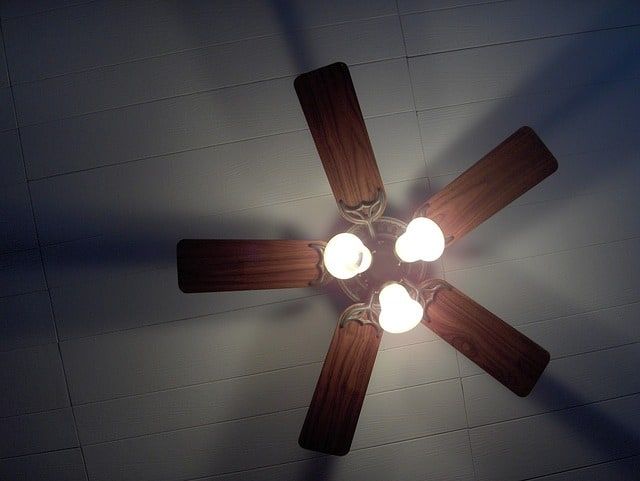
The problems begin the moment a dimmer switch is wired to a ceiling fan motor. The damage is not from "too much voltage" — a phase-cut dimmer can only reduce the average voltage delivered to a load, never raise it above the mains rating. The real failure mode is heat.
At low dimmer settings, the chopped waveform starves the motor of the torque it needs to spin. The motor may stall or rotate sluggishly while still drawing current, and that current is dissipated as heat in the windings. Sustained operation in that state breaks down winding insulation, can destroy the motor, and is a documented fire hazard.
Sustained overheating degrades motor windings and, in unattended installations, can create a fire hazard — particularly in older homes with less heat-tolerant wiring insulation. There's also a secondary issue at the dimmer itself: an inductive motor produces voltage spikes when the waveform is chopped, and a light dimmer doesn't have the snubber circuitry to absorb them, so the dimmer's TRIAC takes a beating too.
Common Symptoms of a Dimmer Switch on a Ceiling Fan
If a fan is already running off a standard dimmer, the warning signs tend to show up early:
- Buzzing, humming, or groaning noise, especially at low speeds
- Fan cannot reach its rated maximum speed
- Fan fails to start on low settings
- Gradual speed reduction over weeks or months of use
- Motor warm or hot to the touch after short operation
Electricians often trace homeowner complaints about a steadily slowing fan back to a dimmer that's been quietly cooking the motor. The buzzing or humming noise is the most common giveaway.
What to Do If a Dimmer Is Already Installed
If you discover a standard dimmer wired to a ceiling fan — for example, after moving into a home where a previous owner did the install — treat it as something to fix before running the fan again, not a 'it's been working, leave it alone' situation.
- Turn the fan off at the wall switch and at the breaker.
- Look and smell for damage: discolored faceplate, scorch marks around the dimmer, warm dimmer body, any burning smell from the fan canopy or ceiling box.
- Replace the dimmer with a fan-rated speed controller before energizing the circuit again.
- If there's any sign of heat damage to the motor, dimmer, or wiring, have a licensed electrician inspect before reusing the circuit — winding damage isn't always visible from outside.
Dimmer Switch vs. Fan Speed Controller: How They Differ
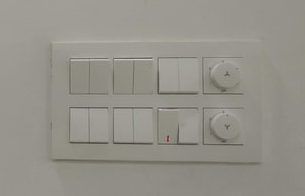
The popular shorthand is that a dimmer switch controls voltage while a fan controller controls current. That's a folk explanation that doesn't survive first-principles physics: in any AC circuit, voltage and current are coupled by the load's impedance, so changing one inevitably changes the other.
The real distinction is what kind of load each device is engineered for.
A standard light dimmer is built for resistive loads (incandescent or LED bulbs). It uses TRIAC phase-cutting — chopping out part of each AC half-cycle — to reduce the average voltage reaching the bulb. With a resistive load, current follows voltage cleanly and predictably.
A purpose-built fan speed controller is built for an inductive load — a motor whose current lags voltage and whose windings produce voltage spikes when the waveform is chopped. Fan controllers use beefier triacs and snubber (R-C) networks to absorb those spikes, and many use discrete capacitive speed taps rather than continuous phase-cutting. Light dimmers do none of this.
Voltage itself is just the difference in electrical potential between two points in a circuit — most commonly between the energized (hot) conductor and neutral. Higher voltage means more energy is available to push current through the load. A phase-cut dimmer reduces that average voltage; it cannot create voltage above what the mains supply already delivers.
It's worth correcting one other piece of folklore: when any AC motor starts, it briefly draws a much higher inrush current — typically several times its running current — for a fraction of a second before the rotor accelerates. This is invisible to the user. A fan started on LOW does not visibly speed up to high and then drop back; it simply ramps to its set speed.
Code and Compliance Considerations
Beyond the safety risk, wiring a standard light dimmer to a ceiling fan motor uses the device outside its UL listing — it isn't rated for an inductive motor load. That's relevant if a home is being inspected, sold, or insured: an inspector who finds an unrated speed control on a fan circuit will typically flag it, and an insurance claim tied to a fire from that wiring can run into trouble. The fix is cheap (a fan-rated controller is usually under $30), so there's little reason to leave a non-compliant install in place.
Older dimmers were typically marked "for incandescent only." Modern dimmers are commonly rated for dimmable LED and CFL bulbs, often labeled "LED+", "CFL/LED", or as "trailing-edge" / "ELV" types. What hasn't changed is that virtually no general-purpose light dimmer is rated for a ceiling-fan motor — fan compatibility, when it exists, is called out explicitly on the device or its packaging.
Related: How Far Should The Light Switch Be From The Door?
What Type of Switch Should Be Used With Ceiling Fans?
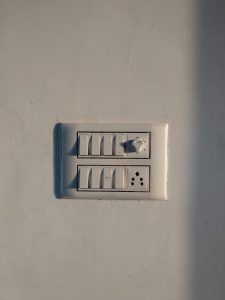
There are three common categories of fan-rated wall control. Which one fits depends on whether the fan has a light kit and how many wires are running from the wall box to the fan.
| Switch Type | Controls | Wires Needed | Smart? | Best For |
|---|---|---|---|---|
| Fan-only speed controller | Fan speed | 2 (single hot to fan) | No | Simple single-fan setups, no light kit |
| Dual fan + light controller | Fan speed + light dim | 3 (separate fan and light hots) | No | Fan with a light kit, separately switched |
| Smart 2-in-1 switch | Fan speed + light | 3 (and neutral) | Yes | App or voice control of fan and light |
A fan-only speed controller (Amazon) is the right choice when the fan has no integrated light, or when the light is controlled separately. A dual fan-and-light controller (Amazon) handles both in one wall plate but requires three conductors between the box and the fan — one for the fan motor, one for the light, plus a shared neutral and ground. A 2-in-1 smart switch (Amazon) does the same job with app and voice integration. These wall controls replace two separate switches for the fan and the light, or the pull string that hangs from the fan itself.
Smart fan/light switches communicate over a range of wireless protocols depending on the product — Wi-Fi, Zigbee, Z-Wave, Thread (often via Matter), or Bluetooth. Wi-Fi switches connect directly to a router. Zigbee, Z-Wave, and Thread devices typically pair to a hub or border router that bridges them to a phone app and to assistants like Google Home or Alexa. The protocol matters mostly at scale: large smart-home installs often avoid pure Wi-Fi for power and congestion reasons.
If Your Fan Has an Integrated Light Kit
Many ceiling fans now ship with a built-in LED light kit. A fan-only speed controller is the wrong device here if you want wall control of the light too — you'll either need a dual fan-and-light wall controller (with a third conductor run between the box and the fan) or a smart switch that handles both channels. Wiring a single fan-only controller to a fan with an integrated light typically means the light is either always on at full brightness or controlled only from the fan's pull chain or remote.
Worth noting: an LED light kit on a ceiling fan should never be dimmed by a generic incandescent dimmer either. If wall dimming of the LED is a goal, the dual fan-and-light controller's light channel needs to be LED-compatible ("LED+" / trailing-edge), and the bulbs themselves need to be marked dimmable.
If Your Fan Has a Pull Chain or Remote
Many fans have their own onboard speed controller, accessed via a pull chain or a handheld/wall-mounted RF remote. In that case the wall switch should be a plain on/off switch, not a speed controller — the fan's own electronics manage speed downstream of constant mains voltage.
Putting a wall speed controller in series with a fan that already has its own remote receiver is the most common way I see people inadvertently confuse two control systems: the fan's electronics expect a clean 120 V supply, and a wall-side phase-cut signal can make the receiver behave erratically or fail outright.
Explore more: Is It Normal For Dimmer Switch To Get Hot?
Final Words
Standard light dimmers and ceiling fan motors are designed for fundamentally different loads, and the failure mode for mixing them — slow heat damage to the motor windings, with a real fire risk in extended use — is serious enough that the fix is non-negotiable: install a fan-rated controller.
If you're unsure whether your current switch is safe, consult a licensed electrician before running the fan. For straightforward replacements, the guide above covers exactly what to look for in a fan-rated controller.